Trin's Veil Subsector
Library Data Milieu 1116 Milieu 1200
| Trin's Veil Subsector | |
|---|---|
 | |
| Sector | Spinward Marches |
| Capital | Trin (Spinward Marches 3235) |
| Number of Systems | 32 |
| Stellar and Economic data | data page |
| Majority Control | Imperium - 100% |
| Map Key | Map Key |
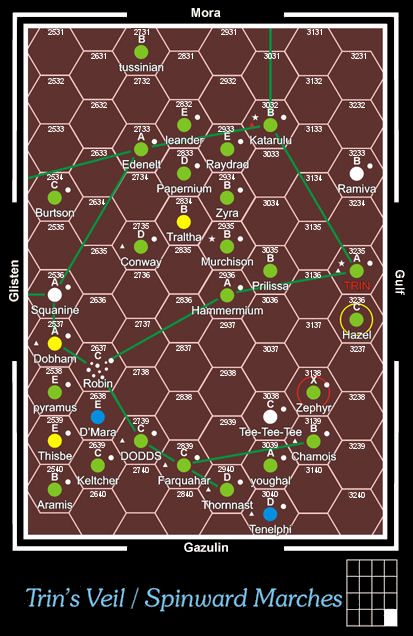
Trin's Veil Subsector is Subsector P of the Spinward Marches.
- It is part of the Imperial Domain of Deneb.
Physical Astrography[edit]
The subsector takes its name from the nighttime view on Trin -- a veil of highly reflective debris, the fragments of a shattered moon, which makes much of the evening and early morning on Trin a bright twilight. [1]
Astrographic Features[edit]
The following astrographic data has been determined regarding Trin's Veil Subsector:
- The subsector is an average stellar density region.
- The brightest star is the red giant primary of the Raydrad system.
Stellar Distribution[edit]
A basic map showing the distribution and size of stars within Trin's Veil Subsector.
- The color corresponds to the visible color of the star, which links to its spectral classification.
- The size as shown indicates both the physical size of the object and its relative brightness.

(Chart sourced from Traveller Map)
Note that the stars as depicted are representative. Any star, no matter what its size, is a mere speck within the hex it occupies.
- Ordinary main sequence stars can barely be seen from even a hex away.
- Huge, intensely luminous giant stars can be seen from across the subsector and far beyond.
World Listing[edit]
Comprehensive Second Survey data for all worlds lying within Trin's Veil Subsector is available.
- The primary source material is the T5SS data and Traveller Map.
- Data is occasionally updated as new information becomes available.
- Older, incorrect, or outdated data is retained for reference.
AAB library archives contain expanded data about the following systems:
Verified updated data is constantly sought.
- Scouting missions gathering reliable, verified data can receive substantial payment.
Non-Canon World[edit]
Ayoreldold is an agricultural world supposedly lying within Spinward Marches Hex 2632.
- It is not marked on modern star charts and may be nothing more than an Old Spacer's Tale.
Mains Clusters & Traces[edit]


High cargo capacity, low jump rating vessels move along the clusters and traces of the sector, carrying vast amounts of goods and commodities between their member worlds. Jump-2 and Jump-3 feeder routes work their ways around the rifts and voids that dot the region, linking the various clusters and traces.
Clusters[edit]
Cluster is a broad astrographic term for groups of between 10 and 50 systems that are accessible by jump-1-capable starships.
Clusters are highlighted in tan: two clusters lie wholly or partially within the subsector.
Traces[edit]
Trace is an astrographic term for groups of between 5 and 10 systems that are accessible by jump-1-capable starships.
Traces are highlighted in brown: one trace-sized cluster of worlds lies partially within the subsector.
History & Background (Dossier)[edit]

Polity Listing[edit]
The following polities can be found within this subsector:
- Third Imperium.
- Imperial Domain of Deneb (ImDd).
Native Sophonts[edit]
The following races (sophont species) are believed to have originated in this area:
- Humaniti (Human races)
- Traltar of Traltha. They have a desert adaptation, an aridity adaptation, a dense atmosphere adaptation, and a taint adaptation.
Demographics[edit]
Significant populations of the following races (sophont species) reside within this area:
- Humaniti (human races)
- Mixed Heritage: widespread across the region.
- Solomani of Terra (major race): many individuals have Solomani ancestry.
- A few worlds have small genetically distinct Solomani populations. These often exist as insular ethnic groups with their own traditions and cultures.
- Traltar of Traltha (minor human race). Almost entirely confined to their homeworld.
- Vilani of Vland (major race): many individuals have Vilani ancestry.
- A few worlds have small genetically distinct Vilani populations. These often exist as insular ethnic groups with their own traditions and cultures.
Linguistic Topography[edit]
A number of languages are spoken within this region:
- Anglic, one of the two official languages of the Imperium.
- Vilani, one of the two official languages of the Imperium.
Politics and Diplomacy[edit]
Military Forces[edit]
The Trin's Veil Subsector is defended by 207th Fleet.
- The fleet is headquartered at Katarulu.
Demographics[edit]
Significant populations of the following races reside within this subsector:
- Humaniti (Human races)
Economic[edit]
The following corporations are active here:
Subsector Timeline[edit]
Major events that have affected this subsector and the wider region that it lies within:
- circa -300,000: the Ancients are active within the sector, most notably transplanting humans from Terra onto Darrian.
- −5823: the Zhodani Consulate is established.
- -4045 to -2204: the Vilani Ziru Sirka controls vast territories.
- after -4045: a few Vilani dissidents fleeing the Ziru Sirka may have passed through the sector.
- -2404 to -2215: the Interstellar Wars. The young Terran Confederation battles against the ancient Ziru Sirka.
- -2400s: Terran explorers pass through the sector, heading generally to spinward and eventually founding settlements in the Theta Borealis region.
- -2204 to -1776: the Rule of Man administers the former Ziru Sirka.
- -1776 to 0: the Rule of Man collapses. Charted Space endures the Long Night.
- -1511: the Itzin Fleet, a group of far-flung Terran traders, contact the Daryens of Darrian. Over the next few centuries Daryen technology advances exponentially.
- Colonists from the Fleet found settlements on a few other worlds within the region.
- -1270: Daryen exploration reaches 20 parsecs from Darrian itself.
- -1137: the Darrian Confederation is founded.
- -1118 to 380: the Aslan Border Wars.
- -924: the Maghiz – the primary star of the Darrian system destabilizes, creating a monumental Electromagnetic Pulse that hits worlds many parsecs away and destroys the now highly advanced Daryen civilization.
- circa -750: Gvegh Vargr from coreward launch sporadic raids into the sector.
- -399: Gram and a number of other worlds in the Sword Worlds Subsector are settled by Terrans fleeing a civil war in the Old Earth Union, in the Solomani Rim. They make their escape from Terra though Aslan Space.
- -200: contact between the Old Earth Union and the Terran settlements in the Sword Worlds Subsector is cut. The long and treacherous route through Aslan Space was made more difficult due to the ongoing Border Wars and the frequent political and territorial changes they caused.
- -187: the Zhodani establish contact with Daryens.
- -186: the Sacnoth Dominate, the first Sword Worlds' government forms.
- The Year 0: the Third Imperium is founded, ending the Long Night.
- 60: Imperial development within the Marches begins in earnest with the settlement of Mora. The Imperial frontier gradually expands into the sector.
- 73: Imperial traders exploring to spinward establish formal contact with the Sword Worlds.
- 75: Regina is settled. A bubble of Imperial territory grows around it.
- before 100: increasing numbers of Vargr settle the relatively empty regions to coreward.
- 148: the IISS make formal contact with Daryens.
- 300: Pretoria, in Deneb Sector, is settled by the Imperium and eventually becomes the administrative center for the Aramis Trace in the Spinward Marches.
- 300-420: the Imperial First Survey charts the subsector.
- 400s: the Zhodani begin settlement within the Marches. They know it as Tloql Sector.
- 589-604: First Frontier War.
- 604-622: the Imperial Civil War.
- 615-620: Second Frontier War.
- 624: the Express Boat Network is established.
- 800-820: the Psionics Suppressions.
- 979-986: Third Frontier War.
- 995-1065: the Imperial Second Survey charts the subsector.
- 1065: the Second Survey is published. Information about the subsector becomes widely available.
- 1082-1084: Fourth Frontier War, also known as the False War.
- 1107-1110: Fifth Frontier War.
Subsector Summary[edit]

Trin's Veil, subsector P of Spinward Marches, contains 32 worlds with an estimated combined population of 15 billion, a per capita income of Cr14,606, and a total economy of BCr222,020. These worlds originate an interstellar trade of BCr5,153 through 27 starports (6 Class A, 9 Class B, 8 Class C, 4 Class D) employing 1,879,530 people. Driving this interstellar trade are seven Agricultural (Ag) worlds, one Non-Agricultural (Na) world, two Pre-Agricultural (Pa) worlds, two Pre-Industrial (Pi) worlds, two Rich (Ri) worlds, and two Industrial (In) worlds. The governments in Trin's Veil maintain eight Scout bases, three Naval bases, and one Way station. The average technology level is 7 (with most between 4 and 10). The highest technology level is 15 at Trin (Spinward Marches 3235).
Trin's Veil, subsector P of Spinward Marches, contains 40 stars and 324 identified planets; 24 monostellar systems, eight binary systems, no trinary systems, and no systems with four or more stars. 27 of the 32 systems (84%) have native gas giants. There are one Asteroid (As) belt, three Desert (De) worlds, no Garden (Ga) worlds, no Ice-capped (Ic) worlds, five Poor (Po) worlds, two Vacuum (Va) worlds, and two Water (Wa) or Ocean (Oc) worlds.
Trin's Veil has an estimated population of 15 billion distributed across two High population (Hi) worlds, one Moderate population (Ph) world, 21 Non-industrial (Ni) worlds, four Low population (Lo) worlds, and no Barren (Ba) worlds. The highest population world is Trin (Spinward Marches 3235). The population consists primarily of 1 sophont group.
| 1 identified sophont population in Trin's Veil | |
|---|---|
|
Third Imperium, Domain of Deneb[edit]
The Third Imperium, Domain of Deneb has jurisdiction over all of the worlds with an estimated combined population of 15 billion, a per capita income of Cr14,606, and a total economy of BCr222,020. These worlds originate an interstellar trade of BCr5,153 through 27 starports (6 Class A, 9 Class B, 8 Class C, 4 Class D) employing 1,879,530 people. Driving this interstellar trade are seven Agricultural (Ag) worlds, one Non-Agricultural (Na) world, two Pre-Agricultural (Pa) worlds, two Pre-Industrial (Pi) worlds, two Rich (Ri) worlds, and two Industrial (In) worlds. The governments in the Third Imperium, Domain of Deneb maintain eight Scout bases, three Naval bases, and one Way station within the subsector. The average technology level is 7 (with most between 4 and 10). The highest technology level is 15 at Trin (Spinward Marches 3235).
The Third Imperium, Domain of Deneb has an estimated population of 15 billion within the subsector, distributed across two High population (Hi) worlds, one Moderate population (Ph) world, 21 Non-industrial (Ni) worlds, four Low population (Lo) worlds, and no Barren (Ba) worlds. The highest population world is Trin (Spinward Marches 3235). The population consists primarily of 1 sophont group.
- The Third Imperium, Domain of Deneb subsector capital of Trin's Veil is Trin (Spinward Marches 3235).
References[edit]
- Marc Miller. The Spinward Marches (Game Designers Workshop, 1979), 34-35.
- Marc Miller. The Spinward Marches Campaign (Game Designers Workshop, 1985), 18-19.
- Marc Miller. Imperial Encyclopedia (Game Designers Workshop, 1987), 94-100. (UWP only)
- Rob Caswell. "Domain of Deneb: Sector Data." MegaTraveller Journal 3 (1992): 47-58. (UWP only)
- Dave Nilsen. The Regency Sourcebook (Game Designers Workshop, 1995), 51. (UWP only)
- Martin Dougherty, Neil Frier. Behind the Claw (Steve Jackson Games, 1998), 117-123.
- Mike West. The Spinward States (Avenger Enterprises, 2008), 115. (UWP only)
- Martin Dougherty. The Spinward Marches (Mongoose Publishing, 2008), .
- Martin Dougherty. Behind the Claw (Mongoose Publishing, 2019), 133-138. (UWP only)
- ↑ Marc Miller. The Spinward Marches (Game Designers Workshop, 1979), 34.