Sword Worlds Subsector
Library Data Milieu 1116 Milieu 1200
| Sword Worlds Subsector | |
|---|---|
 | |
| Sector | Spinward Marches |
| Capital | Gram (Spinward Marches 1223) |
| Number of Systems | 28 |
| Stellar and Economic data | data page |
| Majority Control | Border Worlds - 43% |
| 2nd Control | Sword Worlds Confederation - 35% |
| 3rd Control | Other - 22% |
| Map Key | Map Key |

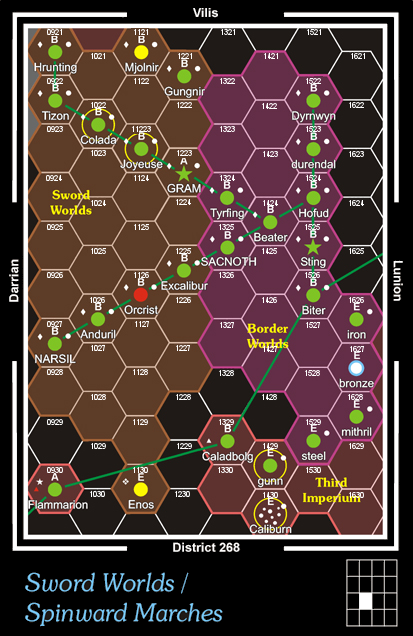
Subsector J of Spinward Marches Sector. Originally settled by Solomani exiles during the period -400 to -200, the Sword Worlds are named for legendary named swords (and other arms) from the varied history of Terra. Names include Tizon and Colada from the spanish El Cid, and Excalibur from the King Arthur epics.
Physical Astrography[edit]
The following astrographic features and trade routes can be found within this subsector:
Mains and Branches[edit]

Traces and Clusters[edit]
Native Sophonts[edit]
There are no native sophont homeworlds in the Sword Worlds subsector.
Politics and Diplomacy : Milieu 1116[edit]
Sword Worlds, subsector J of Spinward Marches, contains 28 worlds with an estimated combined population of 35 billion, a per capita income of Cr6,342, and a total economy of BCr226,935. These worlds originate an interstellar trade of BCr1,546 through 21 starports (3 Class A, 18 Class B, 0 Class C, 0 Class D) employing 549,905 people. Driving this interstellar trade are eight Agricultural (Ag) worlds, no Non-Agricultural (Na) worlds, four Pre-Agricultural (Pa) worlds, three Pre-Industrial (Pi) worlds, nine Rich (Ri) worlds, and three Industrial (In) worlds. The governments in Sword Worlds maintain 20 Military bases, 19 Naval bases, one Way station, and one Scout base. The average technology level is 8 (with most between 4 and 12). The highest technology level is 12 at Gram (Spinward Marches 1223) and Sacnoth (Spinward Marches 1325).
Sword Worlds, subsector J of Spinward Marches, contains 42 stars and 276 identified planets; 15 monostellar systems, 12 binary systems, one trinary system, and no systems with four or more stars. 23 of the 28 systems (82%) have native gas giants. There are one Asteroid (As) belt, two Desert (De) worlds, four Garden (Ga) worlds, one Ice-capped (Ic) world, three Poor (Po) worlds, two Vacuum (Va) worlds, and no Water (Wa) or Ocean (Oc) worlds.
Sword Worlds has an estimated population of 35 billion distributed across three High population (Hi) worlds, four Moderate population (Ph) worlds, seven Non-industrial (Ni) worlds, one Low population (Lo) world, and four Barren (Ba) worlds. The highest population world is Narsil (Spinward Marches 0927). The population consists primarily of 1 sophont group.
| 1 identified sophont population in Sword Worlds | |
|---|---|
|
Sword Worlds Confederation[edit]
The Sword Worlds Confederation has jurisdiction over 24 worlds with an estimated combined population of 35 billion, a per capita income of Cr6,341, and a total economy of BCr226,444. These worlds originate an interstellar trade of BCr1,508 through 19 starports (2 Class A, 17 Class B, 0 Class C, 0 Class D) employing 536,665 people. Driving this interstellar trade are seven Agricultural (Ag) worlds, no Non-Agricultural (Na) worlds, four Pre-Agricultural (Pa) worlds, three Pre-Industrial (Pi) worlds, eight Rich (Ri) worlds, and three Industrial (In) worlds. The governments in the Sword Worlds Confederation maintain 20 Military bases and 18 Naval bases. The average technology level is 8 (with most between 4 and 12). The highest technology level is 12 at Gram (Spinward Marches 1223) and Sacnoth (Spinward Marches 1325).
The Sword Worlds Confederation has an estimated population of 35 billion distributed across three High population (Hi) worlds, four Moderate population (Ph) worlds, five Non-industrial (Ni) worlds, no Low population (Lo) worlds, and four Barren (Ba) worlds. The highest population world is Narsil (Spinward Marches 0927). The population consists of 1 sophont group.
- The capital of the Sword Worlds Confederation is Gram (Spinward Marches 1223).
Third Imperium, Domain of Deneb[edit]
The Third Imperium, Domain of Deneb has jurisdiction over four worlds in the subsector with an estimated combined population of 70 million, a per capita income of Cr7,014, and a total economy of BCr491. These worlds originate an interstellar trade of BCr37 through 2 starports (1 Class A, 1 Class B, 0 Class C, 0 Class D) employing 13,240 people. Driving this interstellar trade are one Agricultural (Ag) world, no Non-Agricultural (Na) worlds, no Pre-Agricultural (Pa) worlds, no Pre-Industrial (Pi) worlds, one Rich (Ri) world, and no Industrial (In) worlds. The governments in the Third Imperium, Domain of Deneb maintain one Naval base, one Way station, and one Scout base within the subsector. The average technology level is 9 (with most between 8 and 10). The highest technology level is 11 at Flammarion (Spinward Marches 0930).
The Third Imperium, Domain of Deneb has an estimated population of 70 million within the subsector, distributed across no High population (Hi) worlds, no Moderate population (Ph) worlds, two Non-industrial (Ni) worlds, one Low population (Lo) world, and no Barren (Ba) worlds. The highest population world is Caladbolg (Spinward Marches 1329). The population consists primarily of 1 sophont group.
Demographics[edit]
Significant populations of the following races reside within this subsector:
- Humaniti (Human races)
- Solomani
- Vilani
- Sword Worlders: A culture of largely Terran descent.
World Listing[edit]
Comprehensive Second Survey data for all worlds lying within the Sword Worlds subsector is available.
- The primary source material for all data is Traveller Map.
- Other sources may differ: some elements of the data may be contradictory or incorrect.
- Data is occasionally updated as new information becomes available.
AAB library archives contain expanded data about the following systems:
Note that some Second Survey data, though only 40 years old, may already be out of date.
- Scouting missions gathering reliable, verified data can receive substantial payment.
Major Historical Events[edit]
Settled at about the same time, the many worlds have progressed at about the same rate technologically, and the worlds are remarkably homogenous socially and culturally. Nevertheless, the relationships between the many worlds have undergone many changes over the centuries. Worlds join together into confederations; those interstellar governments provide a safety of numbers. The precise nature of such confederations ranges from a simple trading community (with preference to its members) to a powerful empire.
In 852, the Sword Worlds Confederation was established with its capital at Joyeuse. It participated in the Third Frontier War on the side of the Zhodani; after the war, a coup by an anti-Imperial faction transferred the capital to Gram.
The perfomance of the Sword Worlds forces during the Fifth Frontier War was faltering and suffered from a lack of cohesive leadership. Following their defeat by the Imperials - and the occupation of Dyrnwyn, Beater, and Biter - the worlds along the Imperial border broke off from the Confederation to create a pro-Imperial puppet state (called the Border Worlds), with its capital at Sting.
All members of the Sword Worlds maintain independent local navies; they patrol their own systems for the protection of trade. The Confederation Charter calls for the confederalization of these forces in times of need; local admirals are then chosen (based on their homeworld's financial, equipment, and troop contributions) to lead fleets on operations.
Subsector Timeline[edit]
Major events that have affected this subsector and the wider region that it lies within:
- circa -300,000: the Ancients are active within the sector, most notably transplanting humans from Terra onto Darrian.
- −5823: the Zhodani Consulate is established.
- -4045 to -2204: the Vilani Ziru Sirka controls vast territories.
- after -4045: a few Vilani dissidents fleeing the Ziru Sirka may have passed through the sector.
- -2404 to -2215: the Interstellar Wars. The young Terran Confederation battles against the ancient Ziru Sirka.
- -2400s: Terran explorers pass through the sector, heading generally to spinward and eventually founding settlements in the Theta Borealis region.
- -2204 to -1776: the Rule of Man administers the former Ziru Sirka.
- -1776 to 0: the Rule of Man collapses. Charted Space endures the Long Night.
- -1511: the Itzin Fleet, a group of far-flung Terran traders, contact the Daryens of Darrian. Over the next few centuries Daryen technology advances exponentially.
- Colonists from the Fleet found settlements on a few other worlds within the region.
- -1270: Daryen exploration reaches 20 parsecs from Darrian itself.
- -1137: the Darrian Confederation is founded.
- -1118 to 380: the Aslan Border Wars.
- -924: the Maghiz – the primary star of the Darrian system destabilizes, creating a monumental Electromagnetic Pulse that hits worlds many parsecs away and destroys the now highly advanced Daryen civilization.
- circa -750: Gvegh Vargr from coreward launch sporadic raids into the sector.
- -399: Gram and a number of other worlds in the subsector are settled by Terrans fleeing a civil war in the Old Earth Union, in the Solomani Rim. They make their escape from Terra though Aslan Space.
- -200: contact between the Old Earth Union and the Terran settlements in the subsector is cut. The long and treacherous route through Aslan Space was made more difficult due to the ongoing Border Wars and the frequent political and territorial changes they caused.
- -187: the Zhodani establish contact with Daryens.
- -186: the Sacnoth Dominate, the first Sword Worlds' government forms.
- The Year 0: the Third Imperium is founded, ending the Long Night.
- 60: Imperial development within the Marches begins in earnest with the settlement of Mora. The Imperial frontier gradually expands into the sector.
- 73: Imperial traders exploring to spinward establish formal contact with the Sword Worlds.
- 75: Regina is settled. A bubble of Imperial territory grows around it.
- before 100: increasing numbers of Vargr settle the relatively empty regions to coreward.
- 148: the IISS make formal contact with Daryens.
- 300: Pretoria, in Deneb Sector, is settled by the Imperium and eventually becomes the administrative center for the Aramis Trace in the Spinward Marches.
- 300-420: the Imperial First Survey charts the subsector.
- 400s: the Zhodani begin settlement within the Marches. They know it as Tloql Sector.
- 589-604: First Frontier War.
- 604-622: the Imperial Civil War.
- 615-620: Second Frontier War.
- 624: the Express Boat Network is established.
- 800-820: the Psionics Suppressions.
- 979-986: Third Frontier War.
- 995-1065: the Imperial Second Survey charts the subsector.
- 1065: the Second Survey is published. Information about the subsector becomes widely available.
- 1082-1084: Fourth Frontier War, also known as the False War.
- 1107-1110: Fifth Frontier War.
Other Powers[edit]
- Double Monarchy (past)
- Five States (past)
- Gram Alliance (past)
- Sacnoth Dominion (past)
- Tizonian League (past)
- Trailing Assembly (past)
- Triple Alliance (past)
- Triple Dominion (past)
- Independent Powers
References[edit]
| This article has a secret. |
- Marc Miller. The Spinward Marches (Game Designers Workshop, 1979), 16-17.
- Marc Miller. The Spinward Marches Campaign (Game Designers Workshop, 1985), 18-19.
- Marc Miller. Imperial Encyclopedia (Game Designers Workshop, 1987), 94-100. (UWP only)
- Rob Caswell. "Domain of Deneb: Sector Data." MegaTraveller Journal 3 (1992): 47-58. (UWP only)
- Dave Nilsen. The Regency Sourcebook (Game Designers Workshop, 1995), 44-45. (UWP only)
- Martin Dougherty, Neil Frier. Behind the Claw (Steve Jackson Games, 1998), 67-73.
- Paul Drye, Hans Rancke-Madsen, Robert Prior. Sword Worlds (Steve Jackson Games, 2004), 22-73.
- Mike West. The Spinward States (Avenger Enterprises, 2008), 109. (UWP only)
- Martin Dougherty. The Spinward Marches (Mongoose Publishing, 2008), .
- Martin Dougherty. Mission to Mithril (Mongoose Publishing, 2018), .
- Martin Dougherty. Behind the Claw (Mongoose Publishing, 2019), 89-92,96-97. (UWP only)
- Martin Dougherty. Sword Worlds (Mongoose Publishing, 2020), .