Difference between revisions of "Shuanyun (world)"
| Line 85: | Line 85: | ||
'''Shuanyun''' is a member of (and the namesake of) the [[Shuanyunu Cluster]], a small [[Main|cluster]] and minor [[trade route]] lying within the central part of [[Taurea Subsector]] of [[Aldebaran Sector]]. | '''Shuanyun''' is a member of (and the namesake of) the [[Shuanyunu Cluster]], a small [[Main|cluster]] and minor [[trade route]] lying within the central part of [[Taurea Subsector]] of [[Aldebaran Sector]]. | ||
| − | Shuanyun and its star ''Gongniu'' have been known to astronomers for millennia and have long been an item of curiosity, but the system has always been on the fringes of human settlement and difficult to reach. While the first manned scientific expeditions visited the infant star | + | Shuanyun and its star ''Gongniu'' have been known to astronomers for millennia and have long been an item of curiosity, but the system has always been on the fringes of human settlement and difficult to reach. While the first manned scientific expeditions visited the infant star in the [[600s|late 600s]], only in the past century has a permanent colony been established. |
The environment in regions within [[Astronomical Unit|2 AU]] of Gongniu is so unusual that iron, nickel, and cobalt-bearing bodies bear little chemical resemblance to those in more normal [[planetoid belt]]s. Hot, bombarded with X-rays, and affected by strong magnetism at an atomic level for nearly a million years, the rocky bodies embedded in the gas of the accretion disk contain ores and alloys unlike anything found in more normal regions of space. The presence of these materials was discovered in [[1047]], during follow-up surveys of the system. | The environment in regions within [[Astronomical Unit|2 AU]] of Gongniu is so unusual that iron, nickel, and cobalt-bearing bodies bear little chemical resemblance to those in more normal [[planetoid belt]]s. Hot, bombarded with X-rays, and affected by strong magnetism at an atomic level for nearly a million years, the rocky bodies embedded in the gas of the accretion disk contain ores and alloys unlike anything found in more normal regions of space. The presence of these materials was discovered in [[1047]], during follow-up surveys of the system. | ||
Revision as of 20:25, 7 July 2025

| Shuanyun/Taurea (Aldebaran 0334) | |||||||||||||||||||||||||
| Classic Era (1116) | CAC3514–C
| ||||||||||||||||||||||||
| See also | UWP | ||||||||||||||||||||||||
| System Details | |||||||||||||||||||||||||
| Primary | K8 V | ||||||||||||||||||||||||
| Planetoid Belts | 1 | ||||||||||||||||||||||||
| Gas Giants | 5 | ||||||||||||||||||||||||
Shuanyun is a nonindustrial fluid world.
- A fluid world has an oceanic geography consisting of heavily contaminated water or a substance such as ammonia, methane, hydrocarbons, or other exotic liquid.
- It requires extensive imports of outside technology to maintain a modern, star-faring society. Having to import most manufactured and high tech goods drives the price up for these items at this world.
- It is a Non-Aligned world dominated by human sophonts located in the Taurea Subsector of Aldebaran Sector.
- This is a frozen world, with a climate of extremely low temperatures.
- This is a "high technology" world with technology achievements at, near, or above the standard for Charted Space.
- It is a member of the Shuanyunu Cluster.
Description (Astrography & Planetology)
Stellar Data
Shuanyun has a solitary primary star.
- The primary is an orange T Tauri star named Gongniu.
Shuanyun has a solitary primary star. Gongniu 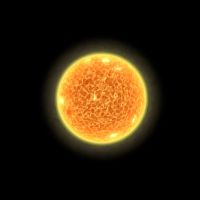
Type Category Mass (Sol) Temperature (K) Luminosity K8 V Main Sequence (Dwarf) 0.62 3930 - 3990 0.18766 Unit Diameter Safe Distance Habitable Zone Jump Shadow M-Drive Limit AU 0.0057 0.0359 0.45 - 0.84 0.57 5.7 Orbit # * * 2 2 6 Remarks Constant flare activity.


Gongniu is an orange-red T Tauri star that is about 800,000 years old and is gradually evolving into a K type main sequence. It is a young stellar object that has not yet started fusing hydrogen in its core - instead, the energy it radiates is powered by material falling into its core as it finishes coalescing from interstellar gas.
- The process of coalescing actually causes the young star to emit more energy than it will in its later, more stable hydrogen-fusing "adult" phase.
System Data

The worlds of the system have been surveyed. They consist of:
- The mainworld, orbiting at an angle to the ecliptic plane in the far outer system.
- x7 secondary rocky worlds. Six are substantial, heavily cratered rocky bodies orbiting within the systems enormous accretion disk and are gradually clearing their orbital paths of debris. The seventh, like the mainworld, orbits above the ecliptic plane in the far outer system.
- x1 planetoid belt: the disk of gas, dust, and small rocky bodies around the star. It is a vast nebulous structure with a radius of more than 200 AU.
- x5 gas giants, all lying within the gas- and volatile-rich far outer system and still in the process of formation.
System Structure
Gongniu is surrounded by a spherical cloud of cold, thin gas about 1,000 AU in diameter, within which is embedded a disk of denser material (the accretion disk) with a radius of around 200 AU. The disk lies on the ecliptic plane and becomes denser, warmer, and far more visible towards its center.
Within about 2 AU of Gongniu, magnetic effects on the motion of the gas within the accretion disk are measurable. The star gathers up gas that approaches within about 0.2 AU, channeling it via its immensely powerful magnetic fields. Eventually some of this material impacts Gongniu's surface, triggering huge but sporadic stellar flares, but most is swept up and blown away in two vast polar jets.
- In the disk and jets, magnetic acceleration heats the material, generating strong bursts of heat, light, and X-rays.
- Matter in the jets moves at 0.001 c, and each jet extends for 0.1 parsec.
Magnetic Fields
High levels of X-rays are always a concern for humans, but within the Shuanyun system the immensely powerful magnetic fields generated by the star's rotation also present major problems.
At around 1 AU the strength of the magnetic field is 5,000 gauss, and it falls off exponentially from there: at 2 AU it is over 600 gauss, at 3 AU it is around 200 gauss, at 10 AU it is around 5 gauss, and so on. It remains as strong as the magnetic field of a typical terrestrial world as far out as 22 AU.
Anyone travelling into a region with a high gauss rating faces a variety of dangers. Objects that are affected by magnetism can become lethal hazards: as the field strength increases past 200 gauss, increasingly large objects can be physically moved, lifted, or made to "go ballistic" by magnetic fields, threatening anything nearby. In areas with magnetic field strengths in excess of 1,000 gauss, even objects that are securely locked down can suffer serious deformation and damage due to "magnetic tides" passing over them.
- Although magnetic field strengths of more than 2,000 gauss can be withstood for days by the human body with no immediate ill effects, fields with strengths in excess of 500 gauss directly stimulate the optic centers of the human brain and produce imaginary lights (phosphenes).
Mainworld Data

Shuanyun orbits at just over 200 AU from Gongniu, in the outer system. It lies at about the same distance from the star as the outer edge of the accretion disk, but has an orbital inclination of 40 degrees relative to the accretion disk's plane of rotation.
- This is away from the worst of the radiation and almost all of the magnetism.

Mainworld Size (S)
Shuanyun is a Big World between 15,200km and 16,800km in diameter. The world has a standard gravity between 1.1G and 1.5G. The horizon will appear about 5.7km away. Vessels with only 1G of thrust should avoid landing on this world.
- The world has a strong Magnetosphere.
Mainworld Atmosphere (A)
Shuanyun has an Insidious Atmosphere which requires the use of a Hostile Environment Suit or Vacc Suit, but extreme conditions cause the corrosive effects to defeat any personal protective measures in a few hours. TL–10 or more advanced survival gear is required to settle this world.
- It experiences very low temperatures.
Mainworld Hydrosphere (H)
Shuanyun has 25-35% of its surface covered by a fluid other than water. Wilderness refueling is not possible. Water for the inhabitants needs to be imported and extensively recycled. These worlds may be Hell Worlds.
- This surface fluid may be ammonia, methane, hydrocarbons, or other exotic liquids depending on the local temperature and environment.

(Blank map, exotic world.)
History & Background (Dossier)

Shuanyun is a member of (and the namesake of) the Shuanyunu Cluster, a small cluster and minor trade route lying within the central part of Taurea Subsector of Aldebaran Sector.
Shuanyun and its star Gongniu have been known to astronomers for millennia and have long been an item of curiosity, but the system has always been on the fringes of human settlement and difficult to reach. While the first manned scientific expeditions visited the infant star in the late 600s, only in the past century has a permanent colony been established.
The environment in regions within 2 AU of Gongniu is so unusual that iron, nickel, and cobalt-bearing bodies bear little chemical resemblance to those in more normal planetoid belts. Hot, bombarded with X-rays, and affected by strong magnetism at an atomic level for nearly a million years, the rocky bodies embedded in the gas of the accretion disk contain ores and alloys unlike anything found in more normal regions of space. The presence of these materials was discovered in 1047, during follow-up surveys of the system.
- Although "down in" (operating within the inner part of the system, close to the young star) presents extreme hazards, mining the exotic materials found there has made many fortunes.
The system's young, active star causes interference, strange tones and noises, and heavy static on commo and sensors, particularly during periods of intense flare activity.
World Starport (St)
Shuanyun has a Class C Starport, an average quality installation which features amenities including unrefined fuel for starships, some brokerage services for passengers and cargo, and a variety of ship provisions. There is a shipyard capable of doing maintenance and other kinds of repair. Ports of this classification generally have only a downport, unless this is a trade port or system with an hostile environment mainworld.
World Population (P)

Shuanyun has a population of 600,000 sophonts (hundreds of thousands).
- This is a Nonindustrial World, too small to support the complete chain of production of most goods from start to finish.
- Around 70% of the population (approximately 420,000 individuals) consists of Solomani humans.
- About 30% of the population (roughly 180,000 individuals) is made up of Taureans.
Linguistic Topography
The most commonly heard languages are:
- Chinese, the collective name for a family of Terran languages that are widely spoken across the region.
- Rim Anglic, a dialect of Anglic and the principal language of the Confederation.
- Taurean, the principal language of the Taureans.
World Technology Level (T)
Shuanyun possesses a Technology Level of TL–12 or TL-C in Hexadecimal Notation.
- Common Communication technologies for this TL include: Holovision, Personal Global Communications, and advanced Translators.
- Common Power Generation technologies for this TL include: Increasingly advanced fusion plants and advanced fuel cells.
- Common Transportation technologies for this TL include:
- Land, Water & Air: Personal G-Tubes and advanced gravcraft.
- Space: Advanced interplanetary spacecraft (System Craft).
- FTL: Jump Drive-3.
World Government (G)

Shuanyun is governed by a Corporate Polity, having a single corporation with a typical corporate structure as a government. Essentially, this is a "company town" (or world). The typical corporate-run world usually has a single purpose. Examples include mining, agriculture, or other kinds of resource extraction. But rather than a simple base of operations, there are facilities for housing workers and their families, including hospitals, schools, and other infrastructure. How, or if, the children of the workers are incorporated into the workforce varies with companies. The corporation running the world may be a subsidiary of a larger interstellar corporation.
The world and the system is controlled by Abaixo LLC. Nothing happens without the tacit approval of the corporation.
- The company Chairman and de facto ruler of the system is Laughton Ferrera.
- A representation of Ferrera's face is used as the company's logo.
World Law (L)
Shuanyun has a moderate law level with laws covering many areas of government and interaction. These laws are simple enough that most people can act as their own advocate, though for serious issues a professional is recommended. Law enforcement officials will be present, but not in great numbers. Light assault weapons, and anything more destructive, are typically regulated or prohibited.
Trade Data
- Importance: 0 (unimportant)
World Economy
- Resources: G (extremely abundant)
- Labor: 4 (tens of thousands)
- Infrastructure: 3 (very limited)
- Efficiency: +2 (good)
World Culture
- Heterogenity: 5 (harmonious)
- Acceptance: 5 (very aloof)
- Strangeness: 5 (distinct)
- Symbols: C (very abstract)
World Timeline
Major events that have affected this world and the wider region that it lies within:
- -9235: far to coreward, the Vilani discover jump drive technology. Over the centuries pioneers and settlers gradually spread across Charted Space.
- -4045 to -2204: the Ziru Sirka controls vast territories.
- -2431: Terrans discover jump drive technology.
- -2404 to -2215: the Interstellar Wars.
- -2204 to -1776: the Rule of Man administers the former Ziru Sirka.
- -1776 to 0: the Long Night.
- The Year 0: to coreward, the Third Imperium is founded.
- 300-420: the Imperial First Survey charts the system.
- 604-622: the Imperial Civil War.
- 624: the Imperial Express Boat Network is established.
- 704: the Solomani Autonomous Region is formed.
- 800-820: the Psionics Suppressions.
- 871: the Solomani Confederation is founded.
- 940: the Solomani Autonomous Region is dissolved.
- 990-1002: the Solomani Rim War.
- 995-1065: the Imperial Second Survey includes data for the system.
- 1065: the Second Survey is published. Information about the system becomes widely available.
References & Contributors (Sources)

|
This article is missing content for one or more detailed sections. Additional details are required to complete the article. You can help the Traveller Wiki by expanding it. |
- John Harshman, Marc Miller, Loren Wiseman. Classic Traveller Supplement 8 Library Data (A-M), (Game Designers Workshop, 1981), various pages. (Library data entries)
- John Harshman, Marc Miller, Loren Wiseman. Classic Traveller Supplement 11 Library Data (N-Z), (Game Designers Workshop, 1982), various pages. (Library data entries)
- John Harshman, Marc Miller. Solomani (Game Designers Workshop, 1986), IFC, pages 3, 28. (sector named, background for the sector)
- Peter G. Celella, James Holden. Solomani & Aslan (Digest Group Publications, 1991), pages 8-11, various others. (dot map locating the worlds of the sector, background for the sector)
- Steven Eric Schwartz. MegaTraveller Periodical Imperiallines 2, 1991, page 5. (Bootean Federation, background for the sector)
- Paul Drye, Jon F. Zeigler. Shuanyun (Journal of the Traveller's Aid Society Online, April 1, 2003). (system details and the Taureans)
- Michael Taylor. Fighting Ships of the Solomani (QuikLink Interactive, 2009), page 5. (background for the sector)
- David L. Pulver. Solomani (Mongoose Publishing, 2012), pages 50, 118, 119, various others. (background for the sector)
- Martin J. Dougherty. The Order of Prometheus (Mongoose Publishing, 2023), various pages. (scenarios and background for the sector)
- Zho Berka's Maps (Classic Era UWP Data for the world)
- CORE Data Site (UWP Data for the world)
- Author & Contributor: Garnfellow (development of the sector)
- Author & Contributor: Leroy W.L. Guatney of the Federation Development Agency (FDA) (development of the sector)
- ↑ "Jump Map API" and map location from Travellermap.com