Difference between revisions of "Baleen class Heavy Tanker"
| (15 intermediate revisions by 3 users not shown) | |||
| Line 1: | Line 1: | ||
{{InfoboxShip | {{InfoboxShip | ||
| − | |name | + | |name = Baleen class Heavy Tanker |
| − | |aerodynam= | + | |image = Distant Fringe Logo.gif |
| − | | | + | |caption = |
| − | | | + | |tdes = RG |
| − | | | + | |type = Tanker |
| − | | | + | | |
| − | | | + | |size-cat = BCS |
| − | | | + | |size = 40000 |
| − | | | + | |hull = Cone Hull |
| − | | | + | |aerodynam = Partially Streamlined Hull |
| − | |crew | + | |TL = 11 |
| − | |enlisted = | + | | |
| − | | | + | |model = Model/4 |
| − | | | + | |jump = 2 |
| − | | | + | |g = 2 |
| − | | | + | |fuelTreatment = Scoops, Purifier |
| − | | | + | | |
| − | | | + | |hp = |
| − | | | + | |weapons = |
| − | | | + | |screens = |
| − | | | + | | |
| − | |IOC | + | |staterooms = 150 |
| − | | | + | |bunks = |
| − | | | + | |seats = |
| − | | | + | |lowberths = |
| − | | | + | | |
| − | | | + | |crew = 222 |
| − | | | + | |officers = 20 |
| − | | | + | |enlisted = 202 |
| − | | | + | |pilots = |
| − | | | + | |marines = |
| − | | | + | |frozenwatch = |
| − | | | + | |passengers = 14 |
| − | | | + | |steerage = |
| − | | | + | |Lpass = |
| − | | | + | | |
| − | | | + | |cargo = 300 |
| − | }} | + | |fuel = 31000 |
| − | The [[Baleen class Heavy Tanker]] is a mercantile | + | |craft = |
| − | + | |features = | |
| − | + | |reserved = | |
| − | + | | | |
| + | |construction = | ||
| + | |origin = Distant Fringe | ||
| + | |manufacturer = | ||
| + | |IOC = | ||
| + | |EOS = | ||
| + | | | ||
| + | |cost = 14948.352 | ||
| + | |architect = 149.483 | ||
| + | |maintenance = | ||
| + | | | ||
| + | |QSP = | ||
| + | |USP = RG-N222242-090000-80006-0 | ||
| + | | | ||
| + | |blueprint = Yes | ||
| + | |illustration = Yes | ||
| + | | | ||
| + | |alsosee = | ||
| + | |canon = | ||
| + | |designer = Ade Stewart | ||
| + | |designSystem = High Guard | ||
| + | |era = 1105 | ||
| + | |ref = Fan: Ade Stewart | ||
| + | |footnote = | ||
| + | }}The [[Baleen class Heavy Tanker]] is a {{TL|11}} mercantile [[Heavy Tanker]]. | ||
* Please also see [[AAB]] article: [[Ships of the Distant Fringe]]. | * Please also see [[AAB]] article: [[Ships of the Distant Fringe]]. | ||
| − | == Description | + | == Description == |
| − | A generic class of civilian vessel, the Heavy Tanker is a large commercial hydrogen fuel transporter commonly encountered throughout the [[Distant Fringe]] region. It is classified as a [[Tanker]] and is constructed as a [[Conventional Pattern Starships|conventional]] design, although in all respects it qualifies as a [[Long-Range Pattern Starships|long-range]] vessel. Similar designs have been in use from the time the [[Distant Fringe]] was first settled. | + | A generic class of civilian vessel, the Heavy Tanker is a large commercial hydrogen fuel transporter commonly encountered throughout the [[Distant Fringe]] region. It is classified as a [[Tanker]] and is constructed as a [[Conventional Pattern Starships|conventional]] design, although in all respects it qualifies as a [[Long-Range Pattern Starships|long-range]] vessel. Similar designs have been in use from the time the [[Distant Fringe]] was first settled. It has a [[crew]] of 222. |
=== Image Repository === | === Image Repository === | ||
| − | [[ | + | # A massive [[Baleen class Heavy Tanker|''Baleen'' class Heavy Tanker]]. <br> [[File:J2 40000dT Heavy Tanker.jpg|600px]] |
=== General Description & Deck Plans === | === General Description & Deck Plans === | ||
| − | The ''Baleen'' class is a partially streamlined cone with a mean diameter of 50 [[meter]]s and a length of around 260 [[meter]]s. Some sections are narrower and some are wider, giving it a total enclosed volume of approximately 540,000 [[Kiloliter|cubic meters]]. Huge [[fuel tank]]s form the majority of the interior of the ship. The main tanks are subdivided into smaller interlinked cells containing baffles, compressors, and pumping equipment, and are separated by service decks. The engineering section is located aft, within the core of the vessel, while the [[bridge]] and accessible sections of the vessel such as the crew quarters and the [[cargo hold]] are located forward. Transfer shafts, offset from one another to reduce the risks associated with accidents or damage, link the various decks together. | + | The ''Baleen'' class is a [[partially streamlined]] [[cone]] with a mean diameter of 50 [[meter]]s and a length of around 260 [[meter]]s. Some sections are narrower and some are wider, giving it a total enclosed volume of approximately 540,000 [[Kiloliter|cubic meters]]. Huge [[fuel tank]]s form the majority of the interior of the ship. The main tanks are subdivided into smaller interlinked cells containing baffles, compressors, and pumping equipment, and are separated by service decks. The engineering section is located aft, within the core of the vessel, while the [[bridge]] and accessible sections of the vessel such as the crew quarters and the [[cargo hold]] are located forward. Transfer shafts, offset from one another to reduce the risks associated with accidents or damage, link the various decks together. |
| − | [[File:J2 40000dT Heavy Tanker Plan.jpg]] <br>A basic [[deck plan]] of the vessel indicating the general layout and positioning of major elements. | + | [[File:J2 40000dT Heavy Tanker Plan.jpg|600px]] <br>A basic [[deck plan]] of the vessel indicating the general layout and positioning of major elements. |
=== Basic Ship Characteristics === | === Basic Ship Characteristics === | ||
| Line 162: | Line 186: | ||
''Baleen'' class ships are [[Gas Trader]]s. They may work with orbital port facilities such as the [[Harbor class Orbital Station|''Harbor'' class Station]]. | ''Baleen'' class ships are [[Gas Trader]]s. They may work with orbital port facilities such as the [[Harbor class Orbital Station|''Harbor'' class Station]]. | ||
| − | |||
| − | |||
| − | |||
| − | |||
| − | |||
=== Class Naming Practice/s & Peculiarities === | === Class Naming Practice/s & Peculiarities === | ||
| Line 172: | Line 191: | ||
While fuel lighters are well built and capable vessels, the various classes see hard service and receive relatively low levels of maintenance. They are driven hard by their owners and commanders, exhausting their crews and further increasing the hazards. The engineering decks, in particular, linked by a single transfer shaft and entirely surrounded by fuel tanks, are considered a death-trap. | While fuel lighters are well built and capable vessels, the various classes see hard service and receive relatively low levels of maintenance. They are driven hard by their owners and commanders, exhausting their crews and further increasing the hazards. The engineering decks, in particular, linked by a single transfer shaft and entirely surrounded by fuel tanks, are considered a death-trap. | ||
| − | + | ||
| − | + | Each variant class is named by the company that produces it: these organizations generally draw on traditional naming protocols. It is not uncommon for a historical class name to be reused. | |
| + | |||
| + | Individual vessels within a class are issued specific serial numbers and [[Transponder|transponder]] codes but traditionally are named by their owners. This is considered a serious affair and a ship with a frivolous name is considered "unlucky". | ||
=== Selected Variant Types & Classes === | === Selected Variant Types & Classes === | ||
| − | + | {{Ship referral tree|name=Tanker| tdes=RG|class1=Civilian Ship|class2=Freighter}} | |
| − | |||
| − | |||
| − | + | == References == | |
| − | |||
| − | |||
| − | |||
| − | |||
| − | == References | ||
{{Metadata}} | {{Metadata}} | ||
{{Intermediate}} | {{Intermediate}} | ||
| − | {{ | + | {{CT-Ship-Design}} |
{{Sources | {{Sources | ||
| − | | | + | | Author: Lord (Marquis) and Master Scout Emeritus [[Adie Alegoric Stewart]] of the [[IISS]] |
| − | |||
| − | |||
| − | |||
}} | }} | ||
| − | |||
| − | |||
[[Category: Distant Fringe Ship]] | [[Category: Distant Fringe Ship]] | ||
| − | {{LEA| | + | {{LEA|Ships|}} |
Latest revision as of 22:07, 4 September 2024
| Baleen class Heavy Tanker | |
|---|---|
 | |
| Type: RG Tanker | |
| Category | BCS |
| Size | 40,000 Tons |
| Hull Configuration | Cone Hull |
| Streamlining | Partially Streamlined Hull |
| Tech Level | TL–11 |
| Engineering | |
| Computer | Model/4 |
| Jump | J-2 |
| Maneuver | 2 G |
| Fuel Treatment | Scoops, Purifier |
| Armaments | |
| Hardpoints | |
| Accommodations | |
| Staterooms | 150 |
| Personnel | |
| Crew | 222 |
| Officers | 20 |
| Enlisted | 202 |
| High/Mid Passengers | 14 |
| Payload | |
| Cargo | 300 Tons |
| Fuel tank | 31,000 Tons |
| Construction | |
| Origin | Distant Fringe |
| Price | |
| Cost | MCr14,948.352 |
| Architect fee | MCr149.483 |
| Statistics | |
| Universal Ship Profile | RG-N222242-090000-80006-0 |
| Images | |
| Blueprint | Yes |
| Illustration | Yes |
| Source | |
| Canon | Unpublished, fan design |
| Designer | Ade Stewart |
| Design System | High Guard |
| Era | 1105 |
| Reference | Fan: Ade Stewart |
The Baleen class Heavy Tanker is a TL–11 mercantile Heavy Tanker.
- Please also see AAB article: Ships of the Distant Fringe.
Description[edit]
A generic class of civilian vessel, the Heavy Tanker is a large commercial hydrogen fuel transporter commonly encountered throughout the Distant Fringe region. It is classified as a Tanker and is constructed as a conventional design, although in all respects it qualifies as a long-range vessel. Similar designs have been in use from the time the Distant Fringe was first settled. It has a crew of 222.
Image Repository[edit]
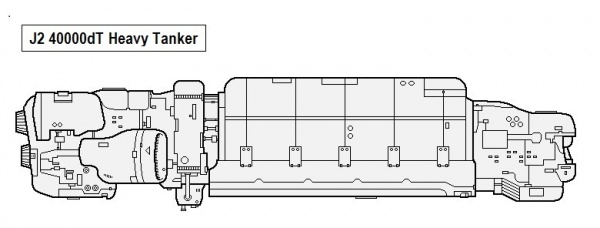
- A massive Baleen class Heavy Tanker.

General Description & Deck Plans[edit]
The Baleen class is a partially streamlined cone with a mean diameter of 50 meters and a length of around 260 meters. Some sections are narrower and some are wider, giving it a total enclosed volume of approximately 540,000 cubic meters. Huge fuel tanks form the majority of the interior of the ship. The main tanks are subdivided into smaller interlinked cells containing baffles, compressors, and pumping equipment, and are separated by service decks. The engineering section is located aft, within the core of the vessel, while the bridge and accessible sections of the vessel such as the crew quarters and the cargo hold are located forward. Transfer shafts, offset from one another to reduce the risks associated with accidents or damage, link the various decks together.

A basic deck plan of the vessel indicating the general layout and positioning of major elements.
Basic Ship Characteristics[edit]
Following the Imperial Navy and IISS Universal Ship Profile and data, additional information is presented in the format shown here. The small craft factor indicates the number of squadrons (...of ten subcraft) carried on the ship. Tonnage on the universal ship profile is shown in kilotons (...thousands of tons) where necessary. [1]
| Basic Ship Characteristics [2] | ||
|---|---|---|
| No. | Category | Remarks |
| 1. | Tonnage / Hull | The Heavy Tanker is constructed using a 40,000 dTon hull built in a generally conical configuration. The hull is fully streamlined, giving good atmospheric performance that is further enhanced by its onboard gravitic systems.
|
| 2. | Crew | Total Crew Complement: 222
Accommodations There are 150 Staterooms.
There are 20 Low Berths. These are tended by the vessel's medic. Accessible areas of the hull are fitted with grav plates and inertial compensators and have full life support and environmental systems.
|
| 3. | Performance | The vessel mounts a DeVoss-type Jump-2 drive, a Maneuver-1 drive, and a Power Plant-2, giving performance of Jump-2, 1-G acceleration, and producing 800 Energy Points. The ship has an agility rating of 1 and an emergency agility of 2. The internal fuel tankage is sufficient for one Jump-2 and gives the power plant 4 weeks duration.
|
| 4. | Electronics | Adjacent to the bridge is a Model/4 Computer: the vessel has a backup Model/4 Computer.
|
| 5. | Hardpoints | x400 hardpoints.
|
| 6. | Armament | The normal weapons fit-out for a Heavy Tanker is: |
| 7. | Defenses | The hull is unarmored.
|
| 8. | Craft | Flight Section
The subcraft are housed in dedicated hangers located at strategic points around the vessel: the hangers can be sealed and have a total volume of 195 dTons. |
| 9. | Fuel Treatment | The vessel has internal fuel tankage of 8,800 dTons.
Commercial fuel tankage amounts to 22,200 dTons. The vessel is designed to be capable of skimming and refining fuel from wilderness sources.
|
| 10. | Cost | The basic cost of the vessel, complete with its complement of subcraft, is MCr18,685.440. |
| 11. | Construction Time | 184 weeks (46 months) as standard.
|
| 12. | Comments | Standard cargo capacity amounts to 300 dTons.
|
History & Background (Dossier)[edit]
The design is representative and a large number of variants exist, particularly with regard to the allotted weapons systems, onboard electronics, and the fit out of internal spaces. Heavy Tankers are designed to skim fuel from gas giant worlds and transport it back to a commercial market, using the onboard refining plant to process and purify the product en route.
Baleen class ships are Gas Traders. They may work with orbital port facilities such as the Harbor class Station.
Class Naming Practice/s & Peculiarities[edit]
A number of companies manufacture ships equivalent to the Baleen class. They vary in hull shape and internal layout but all share the same basic design and all have very similar capabilities and performance characteristics. They are nicknamed "Fuglies".
While fuel lighters are well built and capable vessels, the various classes see hard service and receive relatively low levels of maintenance. They are driven hard by their owners and commanders, exhausting their crews and further increasing the hazards. The engineering decks, in particular, linked by a single transfer shaft and entirely surrounded by fuel tanks, are considered a death-trap.
Each variant class is named by the company that produces it: these organizations generally draw on traditional naming protocols. It is not uncommon for a historical class name to be reused.
Individual vessels within a class are issued specific serial numbers and transponder codes but traditionally are named by their owners. This is considered a serious affair and a ship with a frivolous name is considered "unlucky".
Selected Variant Types & Classes[edit]
38 Representative Tanker (RG) Classes[edit]
Civilian Ship - Freighter - Type RG Tanker
B
C
D
F
G
H
I
J
K
- KA25c Growler class Tanker
- Kandor class Tanker
- Kandor class Tanker
- Kleinnächster class Medium Tanker
L
M
N
O
P
R
S
T
V
Z
References[edit]
| This article has metadata. |

|
This ship was originally designed using one of the Classic Traveller ship design rules:
|
- Author: Lord (Marquis) and Master Scout Emeritus Adie Alegoric Stewart of the IISS
- ↑ Timothy B. Brown. Fighting Ships (Game Designers Workshop, 1981), 10.
- ↑ Timothy B. Brown. Fighting Ships (Game Designers Workshop, 1981), 10.