Difference between revisions of "Comstar class Commo Satellite"
| Line 53: | Line 53: | ||
=== General Description & Deck Plans === | === General Description & Deck Plans === | ||
| − | + | The hull is a simple domed cylinder with a diameter of approximately 5 [[meter]]s, a height of 4.5 [[meter]]s, and a conical base with a height of approximately 0.6 meters. | |
=== Basic Ship Characteristics === | === Basic Ship Characteristics === | ||
Revision as of 15:19, 26 July 2021
| Comstar class Commo Satellite | |
|---|---|
 Distant Fringe object. | |
| Type: WAC Commo Satellite | |
| Category | Smallcraft |
| Size | 5 Tons |
| Hull Configuration | Cylinder Hull |
| Streamlining | Partially Streamlined Hull |
| Tech Level | TL–9 |
| Engineering | |
| Computer | Model/1 bis |
| Jump | J-0 |
| Maneuver | 1 G |
| Armaments | |
| Hardpoints | 1 |
| Accommodations | |
| Staterooms | 0 |
| Personnel | |
| Crew | 0 (automated) |
| High/Mid Passengers | 0 |
| Payload | |
| Cargo | 0 Tons |
| Fuel tank | 0 Tons |
| Construction | |
| Origin | Distant Fringe |
| Year Operational | Early Modern Era |
| End of Service | Still in active service. |
| Price | |
| Cost | MCr10.235 (base) MCr8.188 (qty) |
| Architect fee | MCrAde Stewart |
| Statistics | |
| Quick Ship Profile | W-1C10 |
| Images | |
| Blueprint | No |
| Illustration | Yes |
| Source | |
| Also see | Artificial Satellite |
| Canon | Published, fan design |
| Era | 1105 / 5600AD |
| Reference | Fan: Ade Stewart |
| This spacecraft is designed with the Classic Traveller format, using Book 5 High Guard | |
The Comstar class Commo Satellite is a satellite.
- It is a civilian ship and a small craft.
- Please also see AAB article: Ships of the Distant Fringe.
Description (Specifications)
The Commo Satellite is rugged design that serves in a variety of roles. Most typically it is positioned in a stable orbit around a world and serves as both a defense-related early warning system and a communications relay. Its onboard sensor array may occasionally be used as a scientific observatory or for survey purposes, typically monitoring weather patterns and stellar conditions. Similar designs have been in use from the time the Distant Fringe was first settled.
- The satellite is a TL-9 design.
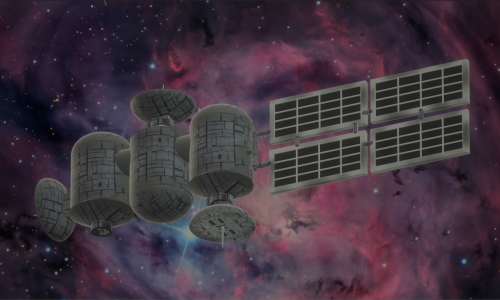
- Multiple Comstar units may be tethered together to carry out specific functions.
Image Repository
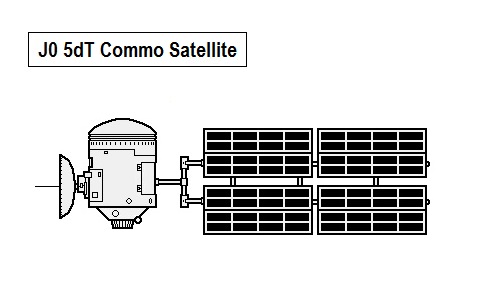
- A Comstar class Commo Satellite.
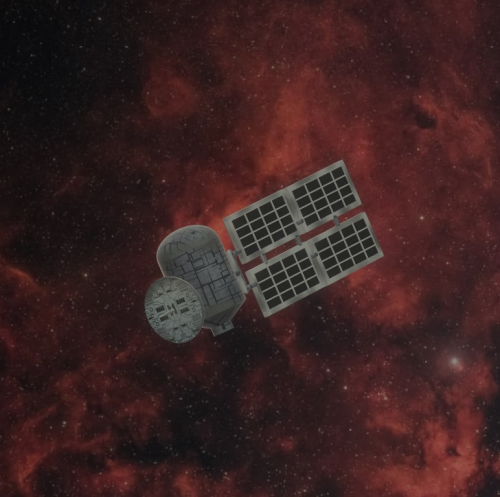
- A typical Comstar performing its function.
- Linked Comstars operating as a single unit


General Description & Deck Plans
The hull is a simple domed cylinder with a diameter of approximately 5 meters, a height of 4.5 meters, and a conical base with a height of approximately 0.6 meters.
Basic Ship Characteristics
Following the Imperial Navy and IISS Universal Ship Profile and data, additional information is presented in the format shown here. The small craft factor indicates the number of squadrons (...of ten subcraft) carried on the ship. Tonnage on the universal ship profile is shown in kilotons (...thousands of tons) where necessary. [1]
| Basic Ship Characteristics [2] | ||
|---|---|---|
| No. | Category | Remarks |
| 1. | Tonnage / Hull | The Commo Satellite is constructed using a 5 dTon hull built in a generally cylindrical configuration. The hull is partially streamlined, giving a relatively limited atmospheric performance that is reliant on its onboard gravitic systems: once it is emplaced the satellite rarely leaves its orbital position.
|
| 2. | Crew | Total Crew Complement: 0 (the satellite is automated).
Maintenance technicians may occasionally board the satellite to perform duties such as refueling, routine maintenance, applying software updates and hardware upgrades, and downloading collected data. Accommodations The compartment is fitted with grav plates and inertial compensators and has basic life support and environmental systems.
|
| 3. | Performance | The satellite mounts a Maneuver-1 drive and a Power Plant-1, giving performance of up to 1-G acceleration (though generally the drives are only used for orbital positioning) and producing 0.06 Energy Points. The satellite has an agility rating of 1. The internal fuel tankage gives the power plant 7 weeks duration at full output: the satellite generally operates in a reduced power mode, drawing additional power from a stellar array, increasing its endurance exponentially.
Stellar Array The satellite mounts an auxiliary fixed stellar collector array, capable of generating enough power to independently run the onboard communications equipment.
|
| 4. | Electronics | The operations compartment contains an acceleration couch and control equipment. The satellite is run by an autonomous Model/1bis Computer: there is a backup Model/1bis Computer.
|
| 5. | Hardpoints | 1 hardpoint.
The satellite has no inherent capacity to mount weapons systems. |
| 6. | Armament | The Commo Satellite is unarmed. |
| 7. | Defenses | The hull is plated and structurally reinforced, giving it an armor rating of 4.
The satellite is not fitted with screens or other passive defensive systems. |
| 8. | Craft | The satellite carries no subcraft. |
| 9. | Fuel Treatment | The satellite has internal fuel tankage of 1 Ton.
|
| 10. | Cost | The basic cost of the satellite is MCr10.029.
|
| 11. | Construction Time | 24 weeks (5.5 months) as standard.
|
| 12. | Comments | The satellite has no cargo capacity.
The Satellite is operated by an autonomous Model/1bis Computer, with another Model/1bis Computer serving as a backup and acting as additional processing capacity.
|
History & Background (Dossier)
The Commo Satellite serves as a component in a Satellite Communication Network. The autonomous onboard computer systems have a good processing capacity but almost no storage, acting primarily as relays for planetary communications. Technically, the satellite is a small craft: its ability to function as such is very limited.
- Commo Satellites are generally deployed in small groups into geosynchronous orbits around a world, relaying data between each orbital unit and the surface.
The Commo Satellite is representative of designs used throughout the Distant Fringe. It is rugged and durable giving it a long service life: the tough hulls are often stripped and refitted with upgraded electronics. Large numbers of variants exist, particularly with regard to the allotted weapons systems and onboard electronics.
Distant Fringe Vessels
The Distant Fringe is said to be a far spinward-rimward area inhabited by colonists and refugees originating on Terra. The region is extremely isolated, separated from the rest of Charted Space by vast, almost uncrossable rifts that were once broached by a system of calibration Points and the use of tankers. Those few academics within Charted Space who have found references to the Distant Fringe regard it as little more than a tall tale. Likewise, many of the inhabitants of the Distant Fringe believe the existence of Charted Space to be mythical.[3]
Vessels originating within the Distant Fringe are very rarely encountered outside of the region. However, misjumps do occur and anomalies with bizarre spacetime and Jumpspace effects exist: as such, craft of this type are not entirely unknown within Charted Space, if only from records found aboard such far-flung craft.[4]
Class Naming Practice/s & Peculiarities
A number of companies manufacture satellites equivalent to the Comstar class. They vary in hull shape and internal layout but all share the same basic design and all have very similar capabilities and performance characteristics.
- Each variant class is named by the company that produces it: these organizations generally draw on approved naming protocols. It is not uncommon for a historical class name to be reused.
- Individual examples of the class are issued specific serial numbers and transponder codes.
Selected Variant Types & Classes
Artificial Satellites – Space Stations:
References & Contributors (Sources)
| This article has metadata. |

|
This article is missing content for one or more detailed sections. Additional details are required to complete the article. You can help the Traveller Wiki by expanding it. |
- Classic Traveller Book 5 "High Guard", GDW, 1980. (Design protocols used)
- Traveller: The New Era Fire, Fusion, & Steel, (Game Designers Workshop, 1994), 65. (Design protocols used)
- Author & Contributor: Lord (Marquis) and Master Scout Emeritus Adie Alegoric Stewart of the IISS
- Author & Contributor: Lord (Marquis) and Master of Sophontology Maksim-Smelchak of the Ministry of Science
- ↑ Timothy B. Brown. Fighting Ships (Game Designers Workshop, 1981), 10.
- ↑ Timothy B. Brown. Fighting Ships (Game Designers Workshop, 1981), 10.
- ↑ Information provided to the library by Maksim-Smelchak
- ↑ Information provided to the library by Maksim-Smelchak