Amkarim class Trade Liner
| Amkarim class Trade Liner | |
|---|---|
| Type: AK Trade Liner | |
| Category | ACS |
| Size | 600 Tons |
| Hull Configuration | Box Hull |
| Streamlining | Unstreamlined Hull |
| Tech Level | TL–11 |
| Engineering | |
| Computer | Model 1/bis |
| Jump | J-1 |
| Maneuver | 1 G |
| Fuel Treatment | scoops, purifier |
| Armaments | |
| Hardpoints | |
| Accommodations | |
| Staterooms | 9 |
| Personnel | |
| Crew | 1 |
| High/Mid Passengers | 16 |
| Payload | |
| Cargo | 423 Tons |
| Fuel tank | 62 Tons |
| Construction | |
| Construction Time | 3 Months |
| Origin | Ziru Sirka |
| Year Operational | -4024 |
| Price | |
| Cost | MCr100.995 |
| Statistics | |
| Quick Ship Profile | RT-BU11 |
| Universal Ship Profile | RT-B6811U |
| Images | |
| Blueprint | Yes |
| Illustration | No |
| Source | |
| Also see | Trade Liner |
| Canon | Unpublished, fan design |
| Designer | Adrian Tymes |
| Era | First Imperium |
| Reference | Fan: Adrian Tymes |
| Designed with Mongoose Traveller High Guard rules, but portable to other versions | |
The Amkarim class Trade Liner is a TL–11 civilian liner.
Description[edit]
"Amkarim" translates as "lonely duty", a title this ship class can live up to. It is a mid-sized bulk hauler with some passenger capacity, to alleviate the boredom of being the ship's lone crew. (Historical records are less than completely clear on this point, but the legend has long since been accepted as gospel truth by Amkarim operators - and it might be true.) It is unarmed, with roll-up cargo hatches to either side that facilitate loading and unloading, whether at port or via pirate, making it a well-known target if caught in unprotected space - so it rarely visits systems known to be dangerous.
The long rectangular frame defines Box Hull for many, only a mid-deck protrusion in front preventing it from being a perfect rectangular prism. The process of the 1G maneuver drive working with lifters to escape a 1.2G gravity well was a standard simulation at certain Second Imperium pilot training facilities right up until the Long Night, and remains available as of 1105 at some of the oldest continually-operated facilities. The same is true of the class's jump dimming procedures: shut off the maneuver drives, make sure the commons appliances are off, briefly suspend active temperature control, and finally dim the lights.
Many surviving Amkarims have been passed down through so many hands, working for outside masters, that some operators - dedicated port crew included - treat it with extensive ritual and ceremony that make no sense to outside observers. There exist small Interface Line corporations based around Amkarims that are difficult to distinguish from cults that happen to provide an income for all involved. These ships enjoy a timeless quality, having been rebuilt piece-by-piece many times over from their initial constructions, long since past the point where age inflicts no further damage. (Those that were not maintained, did not make it to this age. A very few are still manufactured now and then, most often in efforts to pretend to have something very old.)
Image Repository[edit]
Not available at this time.
General Description & Deck Plans[edit]
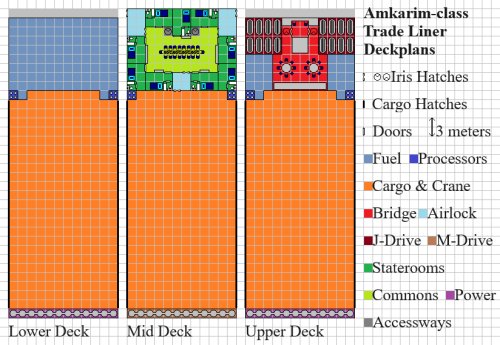
- Deck Plans for this vessel.

Basic Ship Characteristics[edit]
Following the Imperial Navy and IISS Universal Ship Profile and data, additional information is presented in the format shown here. [1]
| Basic Ship Characteristics [2] | ||
|---|---|---|
| No. | Category | Remarks |
| 1. | Tonnage / Hull | Tonnage: 600 tons (standard). 8100 cubic meters. Unstreamlined Box Hull.
|
| 2. | Crew | Crew: 1 Astrogator. 1 virtual Pilot provided via software. |
| 3. | Performance | Acceleration: 1-G maneuver drive installed.
|
| 4. | Electronics | Model/1/bis ship computer. |
| 5. | Hardpoints | No hardpoints. Up to 6 could be installed, but none are by default. |
| 6. | Armament | None. |
| 7. | Defenses | None. |
| 8. | Craft | None. Vacc suits required for EVA (extra-vehicle activity). Rescue Balls for crew and passenger escape normally carried. |
| 9. | Fuel Treatment | It is typically equipped with a fuel purification plant and fuel scoops. |
| 10. | Cost | MCr100.995 (no architect's fees, those having long since been paid). MCr90.8955 in quantity. |
| 11. | Construction Time | 3 months standard, 2 in quantity. |
| 12. | Remarks | A basic carrier of passengers and cargo. One of the oldest human ship designs still in service, and one of the largest ships that only needs a single crew. |
History & Background (Dossier)[edit]
The Amkarim class is older than continuous inhabitation of many, possibly most, worlds in Charted Space. This lends a certain weight of tradition. Officially, the Amkarim class dates to nearly the beginning of the First Imperium; in truth, the design was tinkered with and revised over nearly the entire history of the First Imperium to help divert scientists from work that would substantially change society, and what survives in today's databases is the result of all that plus some updates since then.
It was introduced as the height of Vilani technology in a form that others were permitted to access, particularly the advanced jump-1 drive. By modern standards the surviving design would be considered TL-11; a thorough evaluation of the original design would require a well-enough preserved record of that design.
The Amkarim class was meant for organized service, the sort that modern classification calls a "liner", originally operated by the Bureaux and these days typically operated by medium to large corporations. In particular it was designed for the Vilani Main, though it works for any main with enough regular cargo and/or passenger traffic. It continued to serve many worlds of the Vilani Main during the Long Night, though the number of active ships and their average number of jumps per year notably decreased. The rise of the Third Imperium did not reverse this, instead replacing the diminished service with new ship classes.
Class Naming Practice/s & Peculiarities[edit]
Ship Interior Details: Having been extensively tweaked and tuned for thousands of years, albeit to different ends over that time, the Amkarim class has been said to reek of efficiency, optimization, and minimalism. The only part of the ship meant for habitation is the commons, surrounded by staterooms, and the bridge above.
The commons is dominated by a long table big enough for 18, with equipment and smaller nooks to the sides. Two airlocks lead to the outside, a few meters above the bottom of the landing pads to discourage sneaking aboard, using unfolding ramps to reach the ground if not at a starport with specialized boarding infrastructure. A third, internal airlock leads to the massive cargo bay and typically doubles as the ship's locker, with bulk supplies fed in from the cargo hold then broken down before being brought into the commons.
The bulk of the ship's computer and a few iris valves divide the bridge into a forward section, meant for the astrogator with an optional second console, and a rear section with two holotanks (another improvement over the original version) for passenger entertainment.
The cargo bay is a giant airlock, which may be pressurized or not during any given voyage. Its main occupant is the crane system that shuffles loads around by orders from the bridge.
An Amkarim is not laid out to facilitate maintenance during the trip, though this is possible. Instead, it is designed to facilitate maintenance by outside parties at port. The lone crew during a journey is primarily there to handle astrogation, handling any necessary steward or engineer duties incidentally, with piloting left to the ship's computer.
Class Naming Practice/s: Most Amkarims in service today are named for historical events of the First and Second Imperiums and of the Long Night. Should the Third Imperium someday fall, it is expected that some new Amkarims will start being named for its historical events too.
Selected Variant Types & Classes[edit]
41 Representative Merchant-Liner (AK) Classes[edit]
Civilian Ship - Trader - Type AK Merchant-Liner
A
- Akkigish class Subsidized Merchant
- Amkarim class Trade Liner
- Andrew class Commercial Shuttle
- Anhk class Merchant
B
C
D
F
G
J
- Jasper class Provincial Merchant
- Jelmirt Marquis class High Liner
- Jose Cadiz Royal Galleon class Cargo Carrier
K
L
M
P
R
S
- Seeker class Armored Merchant
- Sirocco class Merchant Freighter
- Star*mart class Provincial Merchant
- Swordfish class Merchant
T
- Trader class Provincial Transport
- Type CT class Cargo Carrier
- Type R2 class Subsidized Merchant
- Type RL class Subsidized Merchant
- Type RL2 class Subsidized Merchant
- Tyrfing class Freighter
V
References[edit]
| This article has metadata. |

|
This ship was designed using Mongoose 2nd ship design rules.
|
- Author: Adrian Tymes
- ↑ Timothy B. Brown. Fighting Ships (Game Designers Workshop, 1981), 10.
- ↑ Timothy B. Brown. Fighting Ships (Game Designers Workshop, 1981), 10.