Difference between revisions of "Monitor"
| Line 77: | Line 77: | ||
| HMH | | HMH | ||
| [[TBD class Heavy Monitor]] | | [[TBD class Heavy Monitor]] | ||
| − | | None | + | | None. (250,000 to 499,999 tons) |
* H = Heavy | * H = Heavy | ||
|- | |- | ||
| Line 83: | Line 83: | ||
| HML | | HML | ||
| [[MacHeany class Monitor]] | | [[MacHeany class Monitor]] | ||
| − | | None | + | | None. (2,500 to 99,999 tons) |
* L = Light | * L = Light | ||
|- | |- | ||
| Line 89: | Line 89: | ||
| HMM | | HMM | ||
| [[MacHeany class Monitor]] | | [[MacHeany class Monitor]] | ||
| − | | None | + | | None. (100,000 to 249,999 tons) |
* M = Medium | * M = Medium | ||
|- | |- | ||
| Line 101: | Line 101: | ||
| HMS | | HMS | ||
| [[Methuselah class System Defense Monitor]] | | [[Methuselah class System Defense Monitor]] | ||
| − | | None | + | | None. (500,000 to 999,999 tons) |
* S = Superheavy | * S = Superheavy | ||
|- | |- | ||
| Line 107: | Line 107: | ||
| HMVL | | HMVL | ||
| [[Vishe class Light Monitor]] | | [[Vishe class Light Monitor]] | ||
| − | | None | + | | None. (100 to 2,499 tons) |
* VL = Very Light | * VL = Very Light | ||
|- | |- | ||
Revision as of 01:30, 15 August 2019
A HM-class Monitor is most often a large spaceship with armament roughly equivalent to a Battleship, often placed in orbit around a mainworld, and used primarily for system defense roles. Generally based on a planetoid hull (...and so automatically unstreamlined), these craft often depend heavily on pre-positioned caches and fuel shuttles.
- They are part of the H-class Defensive Ship grouping and are typically considered paramilitary ships.
- Like battle riders, they are in a conquer-or-die situation if facing superior forces. Their deterrent value is therefore fragile as well as powerful. There are a few exceptions to the rule that are equipped with jump drives.
- The Supraclass designation is also known as Ship Mission, Ship Mission Code, Mission, or Ship Hull Designation.
- It is a starship supraclass.

Library Data Referral Tree
Please refer to the following AAB Library Data for more information:
Starship:
- Advanced Ship Classifications
- Ship Mission Code / Supraclass
- Ship Type Code / Superclass
- Ship Class Code / Class
- Model (TL)
- Bloc (Lot)
- Basic Ship Classifications
- Adventure Class Ship (Auxiliary Class Ship)
- Battle Class Ship (Bulk / Subcapital Class Ship)
- Capital Ship (Capital Class Ship)
- Fleet Class Ship (Capital Class Ship)
- Size-Role Classification
- Subcapital Ship (Small & Large Battle Class Ships)
- QSP
- USP
- World Class Ship
- NAFAL (STL) - (Not As Fast As Light) / (Slower Than Light)
- Light Speed (c)
- FTL - (Faster Than Light) - "Superluminal"
-
- Light-second (ls)
- Light-minute (lm)
- Light-hour (lh)
- Light-day (ld)
- Light-week (lw)
- Light-year (ly)
- Parsec (pc)
Description (Specifications)
Monitors are usually known as large spaceship with armament equivalent to a battleship, used primarily for system defense roles. Generally based on a planetoid hull (...and so automatically unstreamlined), these craft depend heavily on pre-positioned caches and fuel shuttles. The large size of these craft make them generally impossible to move inter-system. Like battle riders, they are in a conquer-or-die situation if facing superior forces. Their deterrent value is therefore fragile as well as powerful. They are generally viewed as more of a mobile fortress than anything else.
Image Repository
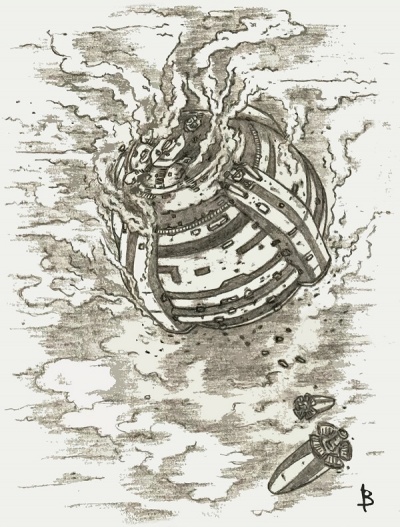
- A Stormrider class Monitor laying up within a gas giant, setting up an ambush for system invaders.

Strategy & Tactics (Doctrine)
Monitors most often operate according to predetermined plans designed to optimize their defensive potential. They are typically stationed at the vital points of a system including gas giants, asteroid belts, mainworlds, and so on. Because they usually have no jump drives, shifting them from system to system can be a problem. Some types have jump shuttles which fit to the craft and provide jump capability. Another method is simple transport in large bulk cargo containers or on ship transporters; the monitors are loaded into many-thousand-ton transports or bulk carriers for the multi-parsec journey. This method, of course, is not recommended if immediate combat is expected at the destination.
Supraclass Roles
Monitors typically serve the following roles:
- Asteroid Monitor (HMP)
- Buffered Asteroid Monitor (HMP)
- Heavy Asteroid Monitor (HMP)
- Light Monitor (HML)
- Medium Asteroid Monitor (HMP)
- Monitor (HM) (Namesake)
- Planetary Monitor (HM)
- Planetoid Monitor (HMP)
- Strike Monitor (HMS)
- System Defense Monitor (HM)
- System Monitor (HM)
Size-Class Roles for Cruiser Vessels
- Utility Craft (U) (1 to 99 tons)
- Very Light Monitor (HMVL) (100 to 2,499 tons)
- Light Monitor (HML) (2,500 to 99,999 tons)
- Medium Monitor (HMM) (100,000 to 249,999 tons)
- Heavy Monitor (HMH) (250,000 to 499,999 tons)
- Superheavy Monitor (HMS) (500,000 to 999,999 tons)
- Ultraheavy Monitor (HMU) (1,000,000 or more tons)
Military Subcraft
Military subcraft (...both smallcraft and bigcraft) are carried by some of these vessels:
- Battle Rider (BR)
- Combat Barge (WBG)
- Combat Transport Smallcraft (UI)
- Fighters (F)
- Militarized Utility Craft (UQ)
Supraclass Archtypes
| HM-class Monitor Supraclass Archtypes | |||
|---|---|---|---|
| Archtype | Type Code/s | Exemplar | Remarks |
| Monitor | HM | Vishe class Light Monitor | Monitors are usually known as large spaceship with armament equivalent to a battleship, used primarily for system defense roles. Generally based on a planetoid hull (and so automatically unstreamlined), these craft depend heavily on pre-positioned caches and fuel shuttles. The large size of these craft make them generally impossible to move inter-system. Like battle riders, they are in a conquer-or-die situation if facing superior forces. Their deterrent value is therefore fragile as well as powerful. They are generally viewed as more of a mobile fortress than anything else.
The term of monitor is also used with smaller craft. Any semi-mobile fortification, lacking jump capability may be known as a system monitor, but are often grouped in other classes.
|
| Heavy Monitor | HMH | TBD class Heavy Monitor | None. (250,000 to 499,999 tons)
|
| Light Monitor | HML | MacHeany class Monitor | None. (2,500 to 99,999 tons)
|
| Medium Monitor | HMM | MacHeany class Monitor | None. (100,000 to 249,999 tons)
|
| Planetoid Monitor | HMP | Empress Troyhune class Planetoid Monitor | None
|
| Superheavy Monitor | HMS | Methuselah class System Defense Monitor | None. (500,000 to 999,999 tons)
|
| Very Light Monitor | HMVL | Vishe class Light Monitor | None. (100 to 2,499 tons)
|
| NOTES: There is semantic overlap between many of the classes and codes. Some codes organize by mission or capability, others by size and tonnage, and yet others by other characteristics. | |||
History & Background (Dossier)

No information yet available.
Selected Variant Types & Classes
Monitor
Paramilitary Ship - Heavy Monitor:
Paramilitary Ship - Light Monitor:
Paramilitary Ship - Medium Monitor:
Paramilitary Ship - Planetoid Monitor:
- Type HMP class Planetoid Monitor
- Defender class Planetoid Monitor
- Empress Troyhune class Planetoid Monitor
- Guardian class Asteroid Monitor
- Hukkert class Monitor
- Methuselah class System Defense Monitor
- Obsidian class Asteroid Monitor
- Peset class Asteroid Monitor
- Porton class Asteroid Monitor
- Sable class Heavy System Defense Monitor
- SH2K Frost G class Medium Asteroid Monitor
- SH7K Fromaag class Heavy Asteroid Monitor
- Temarn class Asteroid Monitor
- Type M2M class Planetoid Battle Station
Paramilitary Ship - Superheavy Monitor:
Paramilitary Ship - Very Light Monitor:
Ship Summary List
Some of the most commonly used vessels in the monitor role include:
| 16 Representative Monitor (HM) Classes | ||||||||||||||||||||||||||||||||||||||||||||||||||||||||||||||||||||||||||||||||||||||||||||||||||||||||||||||||||||||||||||||||||||||||||||||||||||||||||||||||||
|---|---|---|---|---|---|---|---|---|---|---|---|---|---|---|---|---|---|---|---|---|---|---|---|---|---|---|---|---|---|---|---|---|---|---|---|---|---|---|---|---|---|---|---|---|---|---|---|---|---|---|---|---|---|---|---|---|---|---|---|---|---|---|---|---|---|---|---|---|---|---|---|---|---|---|---|---|---|---|---|---|---|---|---|---|---|---|---|---|---|---|---|---|---|---|---|---|---|---|---|---|---|---|---|---|---|---|---|---|---|---|---|---|---|---|---|---|---|---|---|---|---|---|---|---|---|---|---|---|---|---|---|---|---|---|---|---|---|---|---|---|---|---|---|---|---|---|---|---|---|---|---|---|---|---|---|---|---|---|---|---|---|---|
|
| 3 Representative Heavy Monitor (HMH) Classes | |||||||||||||||||||||||||||||||||||||||||||||
|---|---|---|---|---|---|---|---|---|---|---|---|---|---|---|---|---|---|---|---|---|---|---|---|---|---|---|---|---|---|---|---|---|---|---|---|---|---|---|---|---|---|---|---|---|---|
|
| 6 Representative Light Monitor (HML) Classes | ||||||||||||||||||||||||||||||||||||||||||||||||||||||||||||||||||||||||
|---|---|---|---|---|---|---|---|---|---|---|---|---|---|---|---|---|---|---|---|---|---|---|---|---|---|---|---|---|---|---|---|---|---|---|---|---|---|---|---|---|---|---|---|---|---|---|---|---|---|---|---|---|---|---|---|---|---|---|---|---|---|---|---|---|---|---|---|---|---|---|---|---|
|
| 0 Representative Medium Monitor (HMM) Classes | |
|---|---|
| No results |
| 4 Representative Planetoid Monitor (HMP) Classes | ||||||||||||||||||||||||||||||||||||||||||||||||||||||
|---|---|---|---|---|---|---|---|---|---|---|---|---|---|---|---|---|---|---|---|---|---|---|---|---|---|---|---|---|---|---|---|---|---|---|---|---|---|---|---|---|---|---|---|---|---|---|---|---|---|---|---|---|---|---|
|
| 1 Representative Superheavy Monitor (HMS) Classes | |||||||||||||||||||||||||||
|---|---|---|---|---|---|---|---|---|---|---|---|---|---|---|---|---|---|---|---|---|---|---|---|---|---|---|---|
|
| 2 Representative Very Light Monitor (HMVL) Classes | ||||||||||||||||||||||||||||||||||||
|---|---|---|---|---|---|---|---|---|---|---|---|---|---|---|---|---|---|---|---|---|---|---|---|---|---|---|---|---|---|---|---|---|---|---|---|---|
|
References & Contributors (Sources)

|
This article is missing content for one or more detailed sections. Additional details are required to complete the article. You can help the Traveller Wiki by expanding it. |
- Fighting Ships (Classic Traveller Supplement 9)
- Traveller Wiki Editorial Team
- Author & Contributor: Lord (Marquis) and Master of Sophontology Maksim-Smelchak of the Ministry of Science