Difference between revisions of "Starport/es"
(Created page with "=== Puertos en el Consulado Zhodani === El Consulado Zhodani supervisa el desarrollo de sus mundos de mucho más estrechamente que el...") |
|||
| Line 66: | Line 66: | ||
La mayoría de puertos Vargr son operados por firmas privadas contratadas por el gobierno local. Un mundo con un gobierno unificado puede tener un contrato en exclusiva. En los mundos balcanizados puede haber varias instalaciones compitiendo. Aunque los gobiernos locales pueden pedir características concretas (un buen puerto mejora el carisma), los puertos Vargr tienen a construirse, operarse y mantenerse de la forma más barata que sea posible para maximizar los beneficios. {{Page cite|citeName=races}} | La mayoría de puertos Vargr son operados por firmas privadas contratadas por el gobierno local. Un mundo con un gobierno unificado puede tener un contrato en exclusiva. En los mundos balcanizados puede haber varias instalaciones compitiendo. Aunque los gobiernos locales pueden pedir características concretas (un buen puerto mejora el carisma), los puertos Vargr tienen a construirse, operarse y mantenerse de la forma más barata que sea posible para maximizar los beneficios. {{Page cite|citeName=races}} | ||
| − | === | + | === Puertos en el Consulado Zhodani === |
| − | + | El [[Special:MyLanguage/Zhodani Consulate|Consulado Zhodani]] supervisa el desarrollo de sus mundos de mucho más estrechamente que el Imperio, lo que incluye los puertos. Hay varias agencias responsables de las diferentes partes del puerto. Se espera que cooperen entre sí. Los Zhodani prefieren que sus puertos sean autosuficientes y en ese aspecto operan de forma muy parecida a los puertos Imperiales. {{Page cite|citeName=races}} | |
=== Ports on the independent worlds === | === Ports on the independent worlds === | ||
Revision as of 11:41, 12 September 2020

Los astropuertos se han creado para incentivar el comercio interestelar.[1]. Normalmente los astropuertos se componen de una instalación en la superficie y otra en órbita. El recinto en la superficie incluye instalaciones para estibar la carga, un campo de aterrizaje, torres de control, etc. Con frecuencia, a las instalaciones del puerto que está en la superficie se les llama el Planetario (como en el Puerto planetario de Regina) o Puerto planetario. Hay instalaciones en órbita (normalmente en órbita estacionaria encima de la instalación de superficie) para estibar la carga de naves sin aerodinámica y para poder construir de navíos pesados en órbita. Habitualmente a la instalación orbital se le llama Puerto orbital u Orbital (como en el Puerto Orbital de Regina). Los astropuertos de tipo D y E no suelen tener instalaciones orbitales, sólo satélites de navegación o equipo similar. En esos astropuertos, las naves no aerodinámicas deben utilizar lanzaderas. En los astropuertos, al ser el punto principal en el que las astronaves interactúan con un sistema, también se suelen encontrar las otras bases como las navales, del servicio de exploración u otras instalaciones militares y los astilleros espaciales.
El centro principal del tráfico de un sistema es el astropuerto; todos los demás son llamados espaciopuertos. Aunque un espaciopuerto puede aceptar astronaves se les llama (aunque sólo sea por conveniencia y terminología) espaciopuertos. [2][3]
Clasificación de astropuertos
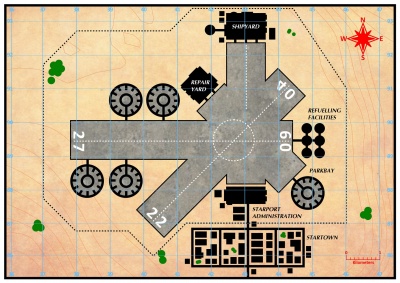
En la forma abreviada del Perfil de Mundo Universal las instalaciones del astropuerto disponible en un sistema se clasifican de la A a la E y X. Esta clasificación incluye los servicios disponibles en el puerto. La clasificación general es:
- Clase A
- Instalación de excelente calidad. Disponible combustible refinado. Disponible reparación general anual. Astillero capaz de construir astronaves y lanzaderas.
- Clase B
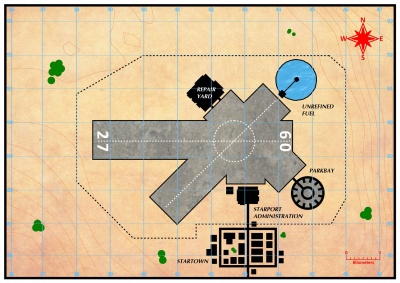
- Instalación de buena calidad. Disponible combustible refinado. Disponible reparación general anual. Astillero capaz de construir lanzaderas.
- Clase C
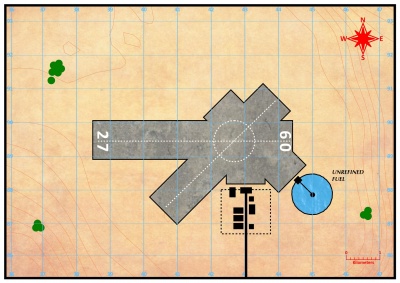
- Instalación de calidad rutinaria. Sólo dispone de combustible sin refinar. Instalaciones de reparación razonables.
- Clase D
- Instalación de calidad pobre. Sólo dispone de combustible sin refinar. Sin instalaciones de reparación.
- Clase E
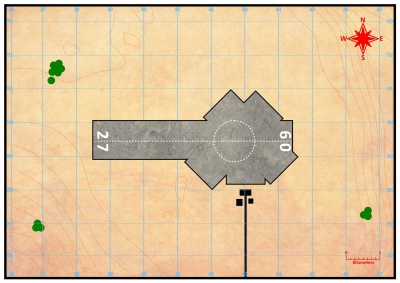
- Instalación de frontera. Esencialmente un punto desnudo en el lecho de una roca sin combustible, instalaciones ni bases.
- Clase X
- Sin astropuerto. La existencia de un astropuerto de clase X normalmente es un indicio de una interdicción. No dispone de zonas de aterrizaje para astronaves y probablemente esos aterrizajes estén prohibidos.
La Autoridad Astroportuaria (AAP) determina las clasificaciones para todos los puertos bajo su control lo que incluye todos los puertos en el Imperio y muchos mundos en sectores alrededor del Espacio imperial. Las clasificaciones portuarias son revisadas con frecuencia por la AAP con informes detallados realizados regularmente. En los puertos de fuera del Imperio la clasificación portuaria es realizada con una revisión del SEII e informes detallados si estuvieran disponibles. Pueden estar incompletos o desfasados.
Críticas a la clasificación
La clasificación de astropuertos condensa varios factores importantes sobre las instalaciones en un código de clasificación. Es posible que un astropuerto incluya algunos rasgos de un puerto de calidad superior o carezca de servicios de su clasificación. No está claro como se asigna una clasificación en estos casos. Un ejemplo, citado con frecuencia, es la disponibilidad (o falta de ella) de combustible refinado. Otro es la capacidad de las instalaciones para realizar reparaciones o revisiones completas.
Tamaño del astropuerto
Una crítica importante del sistema de clasificación de puertos es que no se indica el tamañó del puerto, incluyendo el número de naves potenciales en el sistema que quieran usar el astropuerto y sus instalaciones asociadas. Esta carencia tampoco menciona si el puerto es capaz de manejar naves de tamaños o configuraciones específicas. Aunque se espera que los puertos de calidad más pobre (D o E) tengan menos tráficos (y por lo tanto sean más pequeños) y que los de mayora calidad (A o B) sean más grandes, no siempre es cierto.
El AAP define 5 tipos de puertos.
- Diminuto
- El más pequeño de los astropuertos. Tiene menos de una docena de empleados, la mayoría a tiempo parcial; en un mundo casi vacío donde los empleados del puerto son la mayoría o toda la población mundial, pasan la mayor parte de su tiempo en actividades no portuarias como estudiar el mundo o cultivar comida. El puerto está diseñado para tener unas pocas naves al mes con un tamaño inferior a las 800 toneladas. Están disponibles todas las instalaciones definidas por la clasificación pero habrá pocas opciones, o no las habrá en absoluto, y el servicio puede ser lento.
- Pequeño
- Los puertos pequeños tienen menos de 100 empleados. Las plataformas de aterrizaje e instalaciones operativas tienen el tamaño adecuado para astronaves pequeñas. El tráfico es de unas pocas naves a la semana con algún tipo de servicio regular mensual.
- Mediano
- Es el tamaño más común de puerto. Tiene de 100 a 10.000 empleados. El puerto tiene un tráfico diario regular, centrado en astronaves de tamaño medio y unas docenas de naves más pequeñas al día. Algunos puertos medianos también acogen naves más grandes de manera habitual.
- Grande
- Sólo se encuentran a lo largo de las rutas comerciales más importantes que atraviesan los imperios principales del espacio cartografiado. Tienen un tráfico regular de los más grandes mercantes subsidiados junto con muchos otros tamaños de navíos por lo que necesitan hasta un millón de empleados.
- Muy grande
- Son los más grandes puertos que se pueden encontrar en cualquier parte del espacio cartografiado y, consecuentemente, son escasos. Tienen más de un millón de empleados que manejan un constante e intenso tráfico. Los puertos de este tamaño están divididos en varias localizaciones.
Operación de astropuertos
El operador del puerto o puertos de un mundo depende del gobierno que dirija ese mundo y sus lealtades.
Puertos del Tercer Imperio
Dentro del Tercer Imperio y en numerosos estados clientes y sistemas independientes cerca de las fronteras imperiales los astropuertos son regidos por la Autoridad Astroportuaria como parte del Ministerio de Comercio para el beneficio de todos los mundos que lo componen.
Para facilitar el libre comercio, el Imperium requiere que los mundos miembro cedan un espacio para el comercio. Los astropuertos imperiales son parte del Imperio y dentro de los límites del astropuerto, una zona Extraterritorial, las leyes imperiales sustituyen las leyes planetarias, o su falta de ellas. En un mundo imperial o aliado se puede delimitar esa zona con una simple valla. En mundos activamente hostiles al Imperio, esa zona puede tener un muro fortificado fuertemente patrullado. [4]
Cada puerto es dirigido por un director de puerto asignado por la AAP que le da gran libertad para operar la instalación como vea necesario. La AAP espera que el puerto sea financieramente independiente utilizando la recaudación de las tarifas portuarias para cubrir los gastos incluyendo los salarios, mantenimiento y mejoras del puerto.
Puertos en el Hierato Aslan
Los puertos Aslan son enclaves operados por una corporación en un terreno alquilado al clan o clanes locales. La corporación puede estar asociada al clan que posee la tierra o a un clan asociado. En los sistemas controlados por varios clanes puede haber más de un puerto. En general los puertos proporcionan más servicions a los navíos de los clanes aliados que a los ajenos. Esto puede hacer que el viaje dentro del Hierato sea frustrante. [5]
Puertos en la Federación Hiver
Los Hiver tienen un sistema similar al Imperial. La Agencia Federal para el Desarrollo busca nidos Hiver locales para operar el astropuerto y tienen un nivel de consistencia y eficiencia por toda la Federación. [5]
Puertos en los Dos Mil Mundos
Los Dos Mil Munods tiene una agencia semigubernamental llamada Ghi'rurrikara !kuug'ri que supervisa la construcción de puertos y se asegura que cumplan unos estándares concretos. Los rebaños locales dirigen los puertos. Como es habitual en los K'kree, los puertos orbitales son mucho más grandes de lo esperado y las instalaciones en tierra están muy dispersas. Rara vez hay una zona de extraterritorialidad, sólo hay vallas para evitar el acceso a zonas concretas. [5]
Puertos en la Confederación Solomani
La Confederación no tiene una agencia que regule el mantenimiento de los puertos. Se deja a los miembros individuales de la confederación. El gobierno central Solomani emite unas guías y protocolos para los puertos que se espera que sean seguidas. Esto da un rango de operaciones portuarias mucho más amplio que en el Imperio. [5]
Puertos en la Extensión Vargr
La mayoría de puertos Vargr son operados por firmas privadas contratadas por el gobierno local. Un mundo con un gobierno unificado puede tener un contrato en exclusiva. En los mundos balcanizados puede haber varias instalaciones compitiendo. Aunque los gobiernos locales pueden pedir características concretas (un buen puerto mejora el carisma), los puertos Vargr tienen a construirse, operarse y mantenerse de la forma más barata que sea posible para maximizar los beneficios. [5]
Puertos en el Consulado Zhodani
El Consulado Zhodani supervisa el desarrollo de sus mundos de mucho más estrechamente que el Imperio, lo que incluye los puertos. Hay varias agencias responsables de las diferentes partes del puerto. Se espera que cooperen entre sí. Los Zhodani prefieren que sus puertos sean autosuficientes y en ese aspecto operan de forma muy parecida a los puertos Imperiales. [5]
Ports on the independent worlds
On worlds outside of the major empires, local governments own and operate the local port. In some cases the port is operated by a local corporation, leasing the port from the government. Like the Vargr, the government may insist on specific levels of service which may or may not be available. Like the Hireate, the availability of facilities and services depends upon local allegiances and outsiders may or may not receive the same level of service or have access to all the facilities.
Starport facilities
A starport is a collection of smaller facilities and services operated under the control of the authority operating the port. Starport facilities are distributed among one or more locations.
Destination ports
The standard ports are classified as destination ports where cargo and passengers reach their final destination. These ports are located near population centers or resources required by the populations.
- Downport
- The Downport consists of facilities located on the surface of a planet. Almost all ports have at least some ground component. Landing at the Downport requires craft capable of atmospheric flight and landing. Since some spacecraft lack this capability, it will limit traffic.
- Highport
- The Highport consists of facilities located in orbit around the world, one or more large Orbital Complexes. These stations are usually in stationary or geocentric orbit above the Downport to enable handling of unstreamlined ships, and to allow construction of heavy craft in orbit.
- Beltport
- A Beltport is the location of the starport in an Asteroid Belt system. In design it is between a Highport and a Downport. The advantages of this system have lead some worlds to convert a small planetary moon or move a medium asteroid into planetary orbit to serve as a orbital belt port.
- Subsurface port
- These are port set into or beneath the surface of a planet. This is common on asteroid (e.g. Belt ports), vacuum worlds, underwater ports on water worlds, and other hostile planets. [6]
Transit ports
Transit ports exist to facilitate cargo and passengers moving from destination to destination. Transit ports are located away from population centers. The starport work force is entirely imported from elsewhere making it more expensive to operate than normal ports.
- Trade port
- A Trade port looks like a typical port, but is in a low population system located on a major trade route. There are little cargo and few passengers to or from the world, but the port handles a large volume of ship traffic.
- Farport
- A Farport is an orbital complex located in deep space away from the inhabited planets. This may be a port in orbit around a fuel source like a Gas Giant or in a solar orbit far from the primary star.
- For Example, in systems with giant primary stars, or with multiple stars, access by ship may take an inconveniently long time (a week or more) to travel from the jump break-out to the mainworld. This is an ideal system for a Farport.
- In TL–17 or better empires, ships with Hop Drive will emerge 1000 diameters from the primary star. Farports are therefore situated at this point -- preferably 1000 diameters from a gas giant or ice-capped frozen world, for refueling convenience.
- Deep Space Station
- A deep space station is a starport or port facility located in deep space, outside of any star system. The Deep Space Station serves as a Jump Bridge, allowing ships to travel between two normally inaccessible systems.
Traffic Control
Traffic control manages the arriving and departing ships. They are intended to provide safety and smooth operation at the port via communications. Traffic around ports is generally restricted and controlled, and access to the air and space surrounding the port must be requested and granted.
Traffic control divides space around the port into zones; An Airspace Zone which extends 20 kilometers around the port. An orbital zone which extends from planetary surface to 10 diameters. A transition zone which extends to 100 diameters. And an advisory zone that extends to the outer limits of the system, generally around 100AU or orbit 11. [7]
Traffic control procedures are of two types. Procedural control relies on the craft adhering to published procedures using advisories and information from port control.[8] The ship captain and pilot plot their course to their destination with the advice of starport traffic control. Positive Control relies on the port control to positively identify and track all craft and issue specific directives for operation. [7]. All course plotting is performed by traffic control and craft pilot are expected to follow the directions. Where the traffic control switches from procedural to positive control depends upon the classification of the port and volume of traffic.
Shipbuilding & Overhaul Facilities
Shipbuilding is often associated with ports, with starships being associated with starports rather than spaceports. Ports with shipbuilding facilities will also have repair and maintenance capabilities, although there is no guarantee on availability, particularly to offworlders. Jump drive maintenance and repair may or may not be available at a spaceport.
Outmoded ships may be improved by refitting; obsolete systems are replaced by newer models. All refitting must be done at an A or B starport, and jump drives may be refitted only at class A starports. Refitting involves the complete removal of an old system and the installation of a new one; for instance, if a power plant is refitted, the entire power plant is removed and a new one put in its place. Refitting takes up shipyard capacity equal to the refitting ship's tonnage. Changes in power plant, maneuver drive, or jump drive are major changes.
Full repair may be done at any A or B starport, but jump drive repairs require double cost and time at B starports, and no starport may repair a ship system of higher tech level than the starport's tech level. Repairs require shipyard capacity equal to the ship's tonnage.
Berthing
Berths are where ships land to transfer cargo, passengers, and other sundries that make trade happen. The SPA defines four sizes of ships; 100 tons, 800 tons, 5000 tons, and 20,000 tons, and designs the ports to have a 4-1 ratio between each size. All berths provide a power supply and life support hookups for ship operation while on the surface.
A Downport a berthing spot will be a large, walled open space. Some will offer retractable roofs, often no more than the equivalent of canvas. A few of these berths have no walls, offering only a roof. At the poorest ports, the berthing is simply an open space on the ground. Each berthing spot is connected to the main terminal by a roadway (for the cargo traffic) and a slide way or grav vehicle transport (for passengers).
At a Highport berthing for the smaller ships will be space dock hangers, which can be closed from space for access. Larger ships will attach using external grapples to ensure stable connections.
The final option is orbital berths, where the ship takes up an orbit next to the high port, or at least in a standard orbit, with cargo and passengers are ferried to and from the ship by small craft. This may occur when traffic unexpected overwhelms the port design capacity.
Other Facilities
- Transportation Terminal
- Large ports usually have transportation terminals associated with them tying them into planetary transportation networks. If the terminal is not co-located with the port, there will be shuttle services connecting them. With smaller ports the availability and frequency will be lower. A small port may only offer services during restrict hours. A frontier port may not offer any scheduled services, but ad-hoc and unscheduled services may be available.
- Warehousing
- Warehousing facilities permit rental of space to house cargoes while awaiting sale or transfer to an outbound vessel.[9] Warehousing in orbits may be limited and expensive if storage in a secure space with life support, but is relatively cheap if it involves being parked and monitored in orbit. Warehousing is more likely to be available on the surface, but again the price may depend on local conditions and storage requirements. Availability again relates to the size of the port. Larger ports have more traffic and normally have larger warehousing needs and resources.
- Associated Military & Paramilitary Bases
- Starports, being the primary point at which starships interact with a system, are usually the location for additional bases, such as scout bases, naval bases or other military installations, and for shipyards. In those cases, a portion of the port is normally set aside for military services and personnel.
- Star Town
- Startown is a generic term for an area - usually just outside the XT line - occupied by cheap hotels, grimy taverns, and even less savory places, serving the people who are not quite part of either the local community or the port, but associate with both.[10] For most Imperial ports, the town exists outside the XT line, or a few kilometers down the road. For other ports, the town may be within the starport grounds or straddling the port border.
Services
- Security
- Small and remote ports will not necessarily have organic security, and will usually rely on local law enforcement. If guards are needed, they will most likely need to be hired from local personnel. Access to all but the smallest ports is going to be monitored and people will be questioned if there doesn't appear to be an obvious reason for their presence. Expect more extensive security and monitoring at larger ports, and that access to portions of any port will be restricted. On worlds with ongoing problems (e.g. an Amber Zone world) security may be provided by Imperial Marines or the local equivalent.
- Emergency Services
- The primary port emergency service are the crash, fire, and rescue (CFR) service, for dealing with emergencies. This would include potentially hazardous materials being spilled or released.
- Medical Services
- Every port has at least a first aid station. Class C or better ports will have a doctor or nurse on station at all times with a dedicated office for medical treatments.
- Search and Rescue (SAR) Services
- Major ports have SAR capabilities but the extent of those capabilities is proportionally related to the size of the port. Major ports will have capabilities to operate system wide. Medium sized ports will have more limited capabilities which may only be available within a certain range of the port. Small ports' SAR capabilities will be even more limited. It may be that they only monitor operations via satellite and standard communications and refer information to local authorities for action. Primitive facilities may have no SAR capabilities or they may be restricted to the port itself.
- Life Support Capabilities
- Life support (supplies, air, water, food, and other items) is always available at class A, B, and C ports, but is limited at other locations. The availability at smaller ports is usually determined by the UWP of the world. For example water is going to be available on world with significant water, but food may not be. Ships should stock up on supplies when available rather then depend of availability at smaller ports.
- Brokerage
- Brokerage also usually depends on size but there are exceptions. Any port with a substantial commercial component will have brokers. Therefore it may be difficult or impossible to find a broker on a frontier world. Fortunately, due to the availability of communication, brokers, if available, are not restricted to orbital facilities.
- Shuttle Services
- Ports with orbital facilities will normally provide shuttle services to a ground installation. Large ground facilities will also normally provide shuttle service to orbiting ships. With smaller facilities, private shuttle service may be available. There may also be ground shuttle services connecting ground facilities to transportation hubs, if they are not co-located the the port.
- Travellers' Aid Society (TAS)
- TAS facilities are not available at all ports but are common in class A, B, and C ports. Even when TAS facilities are available, the types of amenities vary.
- Lodging & Entertainment
- Large ports will have restaurants, hotels, casinos, bars, and other facilities associated with them. Smaller ports will normally host at least a restaurant and have some lodging available in close proximity to the port. At primitive and frontier locations anything goes.
- Fuel
- Usually unrefined fuel is available at most ports where the hydrosphere rating is one or above. Where it is not, expect prices to be greatly elevated due to the fuel transportation costs from gas giants, other planets, or ice asteroids. Often on worlds with available water fuel costs may be less at ground facilities than at the orbital ones.
- Naval Architect
- An office or company to perform ship design. May also be required for any upgrades to ships to ensure the new changes won't cause damage to the ship.
Starport in a time of war
A world’s starport is usually the first objective of an invader. The starport usually is close to several other nexuses, and controlling it gives access to the world’s traffic-control systems, which can at least make an attempt to track objects in orbit.[11]
In addition access to the other facilities of the port like refueling capabilities and the shipyard, are important reasons to capture the port intact. It also gives reason it would be the most heavily defended part of any world.
During the Rebellion, Starports became a major target of the Black War efforts on both sides. Standing head-and shoulders above the other reasons for the decline of starports is Lucan's scorched earth policy regarding his rivals' interstellar resources. If he could not retain an important resource, then it must be destroyed to deny it to the enemy. [12]
Starport construction
Worlds with better starports will benefit significantly more from trade than will those worlds with lesser starports. Worlds with starports of less than C do not really benefit from interstellar trade, other than the availability of resources on the interstellar market. Worlds with D class starports only begin to benefit with three or more trade partners worlds, and even then it only benefits marginally. Worlds with E class starports only benefit from trade in empires comprising hundreds of worlds. Of course, worlds with no starport never benefit from interstellar trade. [13]
There are a number of reasons that an interstellar state would need to improve the quality of their member worlds' starports. Starport type is a limit on Tech Level growth. Higher class starports can increase the economic growth through trade. Finally, only certain starport classes can produce certain types of military units needed for defense. Therefore, at key points during the system's growth, there will be a desire to upgrade a system's starport.[14]
The larger challenge of building a port, though the better class of port can be very expensive to build, is having the port traffic to maintain it. The SPA, and the equivalent organizations in other empires, desire the ports to be self sufficient. Meaning the budget to maintain facilities, pay salaries of the workers, and so on needs to come from various port fees. While a few worlds have attempted the "build it and they will come" approach, very few of these succeed.
Colección de imágenes
- Astropuerto-A

- Astropuerto-B
- Astropuerto-C
- Astropuerto-D
- Astropuerto-E


See also
Starport Facilities
- Starport Types
- Facilities
- Services
Universal world profile
- Main world
- Hex Number
- Universal World Profile
- Starport (Sp)
- Planetary Size (S)
- Atmosphere (A)
- Hydrosphere (H)
- Population (P)
- Government (G)
- Law Level (L)
- Tech Level (TL)
- Trade classification & Sophont Codes
- Importance Extension (Ix)
- Economic Extension (Ex)
- Cultural Extension (Cx)
- Nobility
- Bases
- Travel Zone
- PBG - Population, Belts, Giants
- P: Population Multiplier
- B: Belts
- G: Gas Giants
- Worlds
- Allegiance Code
- Stellar Data
References & Contributors (Sources)

|
This page uses content from Wikipedia. The original article was at Airport. The list of authors can be seen in the page history. The text of Wikipedia is available under the Commons Attribution-ShareAlike 3.0 Unported License. |
|
|
This page uses content from Wikipedia. The original article was at Port. The list of authors can be seen in the page history. The text of Wikipedia is available under the Commons Attribution-ShareAlike 3.0 Unported License. |
|
|
This page uses content from Wikipedia. The original article was at Spaceport. The list of authors can be seen in the page history. The text of Wikipedia is available under the Commons Attribution-ShareAlike 3.0 Unported License. |
- Marc Miller. Worlds and Adventures (Game Designers Workshop, 1977), 1,9,10.
- S. L. A. McIntyre. "Port Facilities". White Dwarf 22 (Dec/Jan 1981), 22
- Marc Miller. The Spinward Marches (Game Designers Workshop, 1979), 36.
- John Harshman, Marc Miller. Trillion Credit Squadron (Game Designers Workshop, 1981), 34, 36, 37, 38, 44.
- John Harshman, Marc Miller, Loren Wiseman. Library Data (N-Z) (Game Designers Workshop, 1982), 23.
- Marc Miller. Scouts (Game Designers Workshop, 1983), 28.
- Thomas M. Price. "Happy Landings: Starport Design in Traveller" White Dwarf 43 (July 1983), 26-28
- Marc Miller. Referee's Manual (Game Designers Workshop, 1987), 19,22,25.
- Terrance McInnes. COACC (Game Designers Workshop, 1989), 74-81.
- Dale L. Kemper. "The Compleat Starport." Far & Away 01 (1990): 20-25.
- J. Andrew Keith. "The Compleat Starport Supplementary Material For Megatraveller." Starships, Starports & Vehicles Vol. 1 No. 3 (October 1990), 1-5
- Kevin Knight. "House Rules." Traveller Chronicle 04 (1994): 28-37.
- J. Andrew Keith. Starport Planetfall (Cargonaut Press, 1998), 9-10.
- Jon F. Zeigler. First In (Steve Jackson Games, 1999), 92.
- Steve Daniels, Jim McLean, Christopher Thrash. Far Trader (Steve Jackson Games, 1999), 58-67.
- John M. Ford, James D Maliszwski. Starports (Steve Jackson Games, 2000), 7-16,56-88.
- Carl Walmsley. Starports (Mongoose Publishing, 2011), 42-65.
- Citation Missing - 21 Starport Places
- Citation Missing - Going Portside
- Marc Miller, Robert Eaglestone, Don McKinney. Starships (Far Future Enterprises, 2019), 22-29.
- Marc Miller, Robert Eaglestone, Don McKinney. Worlds and Adventures (Far Future Enterprises, 2019), 24.
- Contributor: Lord (Marquis) and Master of Sophontology Maksim-Smelchak of the Ministry of Science
- ↑ Marc Miller. Scouts (Game Designers Workshop, 1983), 26.
- ↑ Marc Miller. Scouts (Game Designers Workshop, 1983), 41.
- ↑ Marc Miller. Referee's Manual (Game Designers Workshop, 1987), 22.
- ↑ John M. Ford, James D Maliszwski. Starports (Steve Jackson Games, 2000), 42.
- ↑ 5.0 5.1 5.2 5.3 5.4 5.5 Thomas L. Bont, Robert Prior, Christopher Thrash. Starships (Steve Jackson Games, 2003), 14-16sb.
- ↑ John M. Ford, James D Maliszwski. Starports (Steve Jackson Games, 2000), 61.
- ↑ 7.0 7.1 Steve Daniels, Jim McLean, Christopher Thrash. Far Trader (Steve Jackson Games, 1999), 62.
- ↑ Steve Daniels, Jim McLean, Christopher Thrash. Far Trader (Steve Jackson Games, 1999), 63.
- ↑ J. Andrew Keith. Starport Planetfall (Cargonaut Press, 1998), 10.
- ↑ John M. Ford, James D Maliszwski. Starports (Steve Jackson Games, 2000), 44.
- ↑ Douglas E. Berry. Ground Forces (Steve Jackson Games, 2000), 73.
- ↑ Charles E. Gannon. Hard Times (Game Designers Workshop, 1991), 32.
- ↑ David Burden. Pocket Empires (Imperium Games, 1997), 42.
- ↑ David Burden. Pocket Empires (Imperium Games, 1997), 50.