Zip class Courier Drone
| Zip class Courier Drone | |
|---|---|
| Type: R Freighter | |
| Category | Smallcraft |
| Size | 10 Tons |
| Hull Configuration | Wedge Hull |
| Streamlining | Streamlined Hull |
| Tech Level | TL–12 |
| Engineering | |
| Computer | Model/1 |
| Jump | J-0 |
| Maneuver | 7 G |
| Fuel Treatment | Scoops |
| Armaments | |
| Hardpoints | 0 |
| Accommodations | |
| Staterooms | 0 |
| Personnel | |
| Crew | 0 |
| High/Mid Passengers | 0 |
| Payload | |
| Cargo | 5.7 Tons |
| Fuel tank | 1 Tons |
| Special features | Grappling Arm |
| Construction | |
| Origin | Second Imperium |
| Year Operational | -2148 |
| Price | |
| Cost | MCr4.63 |
| Statistics | |
| Quick Ship Profile | R-1L70 |
| Images | |
| Blueprint | Yes |
| Illustration | No |
| Source | |
| Canon | Unpublished, fan design |
| Designer | Adrian Tymes |
| Design System | Mongoose 2nd |
| Era | 1105 |
| Reference | Fan: Adrian Tymes |
The Zip class Courier Drone is a TL–12 Multipurpose Utility Craft operating as a drone.
It is sometimes found in a swarm with examples of the Fuelbag, Mint, Icepick, Quarter Hammer, and System Defense Brick drone classes.
Description (Specifications)[edit]
Sometimes bootstrap expeditions using drones to reestablish industry find the colony does not even have boats to take minerals, harvested from local asteroid belts, down to the planet. At other times, it is simply convenient to deliver small packets directly to destinations across (and sometimes in orbit of) a world, or to organize the output of other drones for easy survey and pickup by larger vessels. For this, there is the Zip drone.
Externally similar to the venerable Type S class Scout/Courier design, if much smaller and internally simpler, a Zip drone is likewise a courier. When it has stopped to take on cargo or make deliveries (usually sitting on its tail if in a planetary gravity well, more often hovering than actually landed), a grappling arm folds out of the front section to perform all cargo handling duties. If confronted with a ball of ore or bundle of raw materials too large to deliver in one pass, which is typically how Mints send their products, Zips' arms are designed to break said products into 5 ton chunks to deliver individually. During construction, most Zips have their arms unfolded, only folding up to achieve their fully streamlined form upon activation and deployment.
Being cheap and fast, individual Zips are sometimes kept at starports with rescue balls, to be used for search and rescue in orbit. With careful packing, over 75 inflated rescue balls can fit within a Zip's cargo bay, more than the entire crew and passenger complement of most smaller starships (which are statistically the most likely to need this sort of assistance). They have also been employed in certain high profile prisoner exchanges. They are also used in media from time to time when something like a Runabout is insufficient; as far as anyone has been able to prove, the recorded adventures of one ship's cat who boarded a Zip hunting a Hiver grub, which caused the Zip to malfunction and launch, only for the cat to subdue the grub, trigger the Zip to return home, and finally deliver the grub to her crew's feet, are entirely true.
Image Repository[edit]
Not available at this time.
General Description & Deck Plans[edit]
- Deck Plans for this vessel.
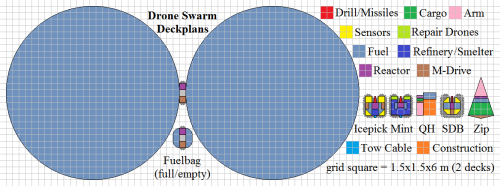

These plans also show data for the Fuelbag, Mint, Icepick, Quarter Hammer, and System Defense Brick classes.
Basic Ship Characteristics[edit]
Following the Imperial Navy and IISS Universal Ship Profile and data, additional information is presented in the format shown here [1]
| Basic Ship Characteristics [2] | ||
|---|---|---|
| No. | Category | Remarks |
| 1. | Tonnage / Hull | Tonnage: 10 tons (standard). 140 cubic meters. Streamlined Hull.
|
| 2. | Crew | Crew: no sophonts. Software provides virtual Pilot. |
| 3. | Performance | Acceleration: 7-G maneuver drive installed.
|
| 4. | Electronics | Model/3. |
| 5. | Hardpoints | Too small for hardpoints. 1 firmpoint, unused. |
| 6. | Armament | None. |
| 7. | Defenses | None. Usually reliant on being able to outrun any attackers. |
| 8. | Craft | None (besides itself). With no crew, vacc suits and Rescue Balls are not normally carried. |
| 9. | Fuel Treatment | It is not equipped with a fuel purification plant or fuel scoops. |
| 10. | Cost | MCr4.63. MCr4.167 in quantity. (The architect's fees were amortized long ago.) Known to high precision after extensive manufacture by Quarter Hammers. |
| 11. | Construction Time | 5 days standard, 4 in quantity. Quarter Hammers (which construct the majority of this type) build one at a time, and thus use the standard rate. |
| 12. | Remarks | A simple delivery drone. |
History & Background (Dossier)[edit]
See Quarter Hammer class Construction Drone, which Zips were created to assist.
Independent use arose afterward, when terminated (or, sometimes, excessively successful) Quarter Hammer projects resulted in surplus Zip drones, that could be put to use independently of the other drone types it is associated with. Like many spaceships, its considerable expense (relative to grav vehicles, since it often operates at an altitude less than double a planet's radius) means it is only employed where there is enough traffic for it to remotely make sense, though in many cases this is less a question of "if" but "how many". That said, Zip drones have proven useful useful anywhere where fast, interplanetary delivery of small cargoes is needed. Certain high population worlds employ them to never go beyond orbit, finding them useful for express (if expensive) deliveries at merely intercontinental distances.
The basic and relatively simple Zip drone class has not changed much over time. Enough examples survived the Long Night that, when the Third Imperium recovered TL-12 manufacturing capability, the Zip was simply reverse-engineered instead of rearchitected.
Despite the external similarity (size aside), recorded history shows the IISS naval architects were not specifically aware of the Zip when they designed the Type S class Scout/Courier, though they did take many of the same design criteria into account.
Class Naming Practice/s & Peculiarities[edit]
Zips are almost always known by numerical identifiers, and will generally identify themselves as such when interacting with local traffic control. Of the drone types they are associated with, Zips are the most likely to be assigned names, though their programming regards these as nicknames (to be acknowledged when used, then discarded once the sophonts who care about a given nickname are no longer on duty), and their numerical designation as their true names. "I am a number, not a free drone" is a common in-joke among those who deal with Zips extensively.
Selected Variant Types & Classes[edit]
55 Representative Freighter (R) Classes[edit]
Civilian Ship - Freighter - Smallcraft - Type R Freighter
A
C
D
E
F
G
H
- Haddox class Merchant Cruiser
- Hercules class Cargo Transport
- Hummingbird class Courier
- Hummock class Replenishment Ship
J
- Jack Driscoll class Bulk Freighter
- Jade Serpent class Fleet Support Vessel
- Jembyra class Recovery Boat
K
L
- Last Armada class Heavy Transport
- Leo class Ship's Boat
- Leviathan class Merchant Cruiser
- Liz Zhorka class Light Trader
- Logos Minos class Fleet Scout
M
- Magnadon class Provincial Merchant
- Mariner class Frame Carrier
- Maru class Merchant
- Mountain class Replenishment Ship
O
P
- Panam Ajax class Logistics Transport
- Panther class Repair Vessel
- Pegasus class Bulk Cargo Carrier
- Pinnace
- Prosperity class Freighter
R
S
- Slow Pinnace
- Slow Pinnace
- Solostar class Far Trader
- Suluru class Mercantile Carrier
- Susa class Cargo Carrier
- Swift Dreams class Colonial Transport
T
- Triad class Merchant
- Type AT class Freighter
- Type RAX class Protected Merchant
- Type TC(S) class Free Trader
- Type TI class Merchant
- Type TJ class Merchant
V
W
Y
Z
References[edit]
| This article has metadata. |

|
This ship was designed using Mongoose 2nd ship design rules.
|
- ↑ Timothy B. Brown. Fighting Ships (Game Designers Workshop, 1981), 10.
- ↑ Timothy B. Brown. Fighting Ships (Game Designers Workshop, 1981), 10.