Wingtruck class Interface Craft
| Wingtruck class Interface Craft | |
|---|---|
| Type: RV Multipurpose Utility Craft | |
| Category | Smallcraft |
| Size | 20 Tons |
| Hull Configuration | Wedge Hull |
| Streamlining | Airframe Hull |
| Tech Level | TL–12 |
| Engineering | |
| Computer | Model/3 |
| Jump | J- |
| Maneuver | 6 G |
| Fuel Treatment | Scoops |
| Armaments | |
| Hardpoints | 1 |
| Offensive | Beam Laser |
| Accommodations | |
| Staterooms | 1 |
| Personnel | |
| Crew | 2 |
| Pilots | 2 |
| High/Mid Passengers | |
| Payload | |
| Cargo | 0.5 Tons |
| Fuel tank | 1 Tons |
| Special features | Docking for 30 ton module |
| Construction | |
| Construction Time | 0.75 Months |
| Origin | Third Imperium |
| Manufacturer | Tukera Lines |
| Year Operational | 104 |
| Price | |
| Cost | MCr22.815 |
| Maintenance cost | Cr1,91 |
| Statistics | |
| Quick Ship Profile | UM-2A60 |
| Universal Ship Profile | UM-C2706A |
| Images | |
| Blueprint | Yes |
| Illustration | Yes |
| Source | |
| Also see | Utility Craft |
| Canon | Unpublished, fan design |
| Designer | Adrian Tymes |
| Design System | Mongoose 2nd |
| Era | Third Imperium |
| Fast interplanetary transport | |
The Wingtruck class Interface Craft is a civilian Utility Craft.
Description[edit]
ARCHIVIST'S NOTE: The Wingtruck design has evolved slightly over time, most notably to accommodate the rise of and changes to standard 30-ton modules. The data presented here is for the most common version as of 1105.
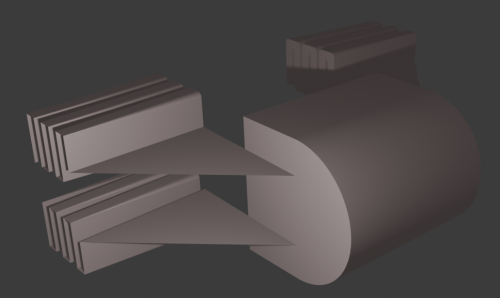
The Wingtruck is a simple concept: fold wings around a variable rear cargo area, to give stability when transporting cargoes through atmospheres, using an oversized maneuver drive to give the same performance unloaded and when hauling maximum recommended cargo displacement. While it can carry cargo of many shapes, it sees its best performance paired with a standard 30 displacement ton module. These modules became more prevalent after the Civil War, centuries after the Wingtruck's debut. There is some evidence that widespread use of Wingtrucks and similar designs led to the rise of said module as a standard.
Aside from the wings - which, when not deployed, can fold up to a 2 deck height to balance the rear of the craft for landing - the craft's cab is a cramped 2 deck affair: maneuver drive and power plant below; cockpit, common room (little more than an extended back of the cockpit), cargo (a small nook to the side), and a split-up stateroom (one bathroom and two "bunkrooms" consisting of little more than a bed and some personal storage) above; sensors and beam laser in front. Access is normally only done when no module is attached, using the hatch that opens to where the module would go, though there is a secondary hatch to one side. Like most smallcraft, a Wingtruck has no internal airlock, so access in vacuum will depressurize the craft.
Being a standardized, common craft that pushes the limits of TL-12 maneuver drive technology, Wingtrucks are often used for racing so as to attempt to equalize the hardware available to competitors and test the pilots' skills. They are also often used as rescue craft, being maintainable anywhere where TL-12 parts can be obtained, a balance that many civilian ship designs strike: higher technology might give better performance but more difficulty in keeping the craft operational. Of course, it is also used for its original purpose of hauling cargo between two worlds in a system where at least one has an atmosphere of note.
While cargo, racing, and rescue are the most well known uses, swapping out the cargo module enables a broad variety of roles. A fuel module turns the Wingtruck into a fuel skimmer, which can drop off a loaded fuel module and accept an empty one for quick turnaround to maximize fuel skimming time. A dedicated survey module pairs well with the enhanced maneuver drive for a fast survey craft. A Wingtruck can drop off a boarding module, hanging back or getting away after delivering its payload to danger. While not optimized for combat use, it is capable at delivering 30 ton explosives if properly escorted. It is for this reason that the second crew member is called a "co-pilot" instead of anything more specific: what the second person does depends on what the Wingtruck is doing. The beam laser is present as a just-in-case, as not all uses need a weapon, though there is space to mount additional weapons if needed - usually a pair of missile racks, since the Wingtruck's power systems are already stressed powering the single laser.
Image Repository[edit]
- A representation, from template files for manufacture and customization, of a Wingtruck with its wings folded for landing.

General Description & Deck Plans[edit]
- Deck Plans for this vessel.


Basic Ship Characteristics[edit]
Following the Imperial Navy and IISS Universal Ship Profile and data, additional information is presented in the format shown here. [1]
| Basic Ship Characteristics [2] | ||
|---|---|---|
| No. | Category | Remarks |
| 1. | Tonnage / Hull | Tonnage: 20 tons (standard). 280 cubic meters. Airframe Hull Wedge Hull.
|
| 2. | Crew | Crew: Pilot, Co-Pilot. |
| 3. | Performance | Acceleration: 6-G maneuver drive installed, able to give 6-G with up to 30 tons additional (such as a 30 ton module) docked.
|
| 4. | Electronics | Model/3. |
| 5. | Hardpoints | 1 firmpoint. |
| 6. | Armament | Fixed mount beam laser. |
| 7. | Defenses | None. |
| 8. | Craft | None. Vacc suits required for EVA (extra-vehicle activity). 1 Rescue Ball for crew escape normally carried. |
| 9. | Fuel Treatment | It is normally equipped with fuel scoops but no fuel purification plant. |
| 10. | Cost | MCr22.815 (no architect's fees, having been paid long ago). MCr20.5335 in quantity. |
| 11. | Construction Time | 3 weeks standard, 2 in quantity. |
| 12. | Remarks | A cargo hauler, racing vessel, rescue craft, and otherwise multipurpose design dating back to the early Third Imperium but still in use on many worlds. |
History & Background (Dossier)[edit]
It is possible that the Wingtruck dates back to before 104, but the currently accepted official start of the design was an interface craft design by Tukera Lines intended to allow speedy response to distress calls, to enable compliance with the Imperial Navigation Act of 103. The advertised aim, which appears to have been realized, was a rescue craft subsidized by its cargo hauling role, which subsidy was the only way that many systems could afford to have a decent rescue capability. This was not the most well known of Tukera's designs, but the megacorporation's influence was among the factors behind this design's early spread.
Use as a standardized racing craft began at some point over the subsequent century on an informal basis. Even in 1105, the major racing circuits rarely employ "Wingtruck rules" - mostly due to the age and lack of novelty of the design - though there are a few local institutions that have hosted Wingtruck racing tournaments every year for over half a millennium. Some racers view competing in one as a rite of passage - not necessarily winning, but with some easily met criteria such as finishing in the top half, or finishing at all if the course is particularly dangerous.
Class Naming Practice/s & Peculiarities[edit]
While exact counts are not available, evidence suggests that the cumulative production count is in the millions. As with most spacecraft classes with such a production count, name standardization has long since become a bygone memory, if it was ever the case in the first place. Wingtruck names depend on the owner's culture and, often, intended primary use as a racer, rescue craft, cargo hauler, or other function.
A Wingtruck does not have enough power to use all systems to the maximum simultaneously. When firing its beam laser, a Wingtruck will usually engage in "beam dimming": just like jump dimming, power from optional-use systems - primarily certain parts of life support such as food preparation - is rerouted for the duration. It is well known among Wingtruck crews that combat and meal preparation should happen at different times, leading to the typical array of humor, as well as to making meals in advance of using the laser if it is known when the laser will be needed. Some Wingtruck crews who engage in belt mining time this so they can be having meals while the beam laser, detuned into a laser drill, "feasts" on a target planetoid.
Selected Variant Types & Classes[edit]
32 Representative Multipurpose Utility Craft (RV) Classes[edit]
Civilian Ship - Freighter - Smallcraft - Type RV Multipurpose Utility Craft
A
B
C
D
E
G
H
I
K
L
M
N
O
P
R
S
T
W
Y
Z
References[edit]
| This article has metadata. |

|
This ship was designed using Mongoose 2nd ship design rules.
|
- Author & Contributor: Adrian Tymes
- ↑ Timothy B. Brown. Fighting Ships (Game Designers Workshop, 1981), 10.
- ↑ Timothy B. Brown. Fighting Ships (Game Designers Workshop, 1981), 10.