Universal Ship Profile

The Universal Ship Profile (USP) or Imperial Ship Profile is a quick, universal code for ships or vessels.
- It is known in many places outside of the Third Imperium as the Universal Craft Profile or UCP.
Please refer to the following AAB Library Data for more information:
Starship:
- Advanced Ship Classifications
- Ship Mission Code / Supraclass
- Ship Type Code / Superclass
- Ship Class Code / Class
- Model (TL)
- Bloc (Lot)
- Basic Ship Classifications
- Adventure Class Ship (Auxiliary Class Ship)
- Battle Class Ship (Bulk / Subcapital Class Ship)
- Capital Ship (Capital Class Ship)
- Fleet Class Ship (Capital Class Ship)
- Size-Role Classification
- Subcapital Ship (Small & Large Battle Class Ships)
- QSP
- USP
- World Class Ship
- NAFAL (STL) - (Not As Fast As Light) / (Slower Than Light)
- Light Speed (c)
- FTL - (Faster Than Light) - "Superluminal"
-
- Light-second (ls)
- Light-minute (lm)
- Light-hour (lh)
- Light-day (ld)
- Light-week (lw)
- Light-year (ly)
- Parsec (pc)
Description (Specifications)
The Imperial Ship Profile is used by the Scout Service to classify ship mission and performance. All together, the ship's vital statistics are presented in one short record.
USP Information Blocks
One version consists of three blocks in this order:
- Ship mission codes
- One number or letter each for:
- Technology level
- Size modifier (such as 4 for 40 tons or 40,000 tons)
- Size indicator (such as 7 for 40 tons or A for 40,000 tons)
- Jump performance (in parsecs per jump)
- Acceleration performance (in Gs)
- Hull configuration
- One letter each to signal the presence of other features
- A: (heavily) Armed (sometimes omitted if the mission code suggests it should be armed, or for light weapons such as a single laser turret on a free trader)
- C: Cold sleep (at least enough low berths to carry the entire crew)
- D: long Duration (extra supplies or stores, and/or the ability to manufacture its own)
- E: Energy weapons (not including spinal weapons)
- K: Kinetic weapons (not including missiles or spinal weapons)
- L: Lab
- M: Missile weapons (including torpedoes, not including spinal weapons)
- N: Nonhumanoid (designed for crew with nonhumanoid body plans)
- S: Spinal weapon
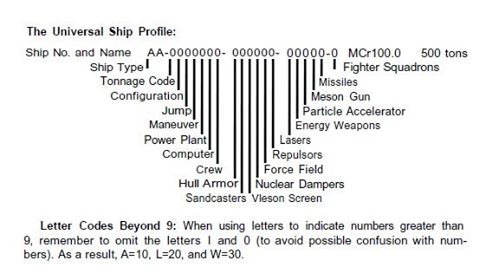
Regardless of version, each position has a "factor" or value that represents an element of the ship. Common elements include hull displacement tons, hull configuration, computer type, weapons, screens, fighters and the number of crew.
Image Repository
- How the Universal Ship Profile works.

History & Background (Dossier)
The usage of the USP in various formats can be traced well back to the First Imperium although scholars argue much of the research.
Selected USP examples
Examples include:
- MT C4831U LC : merchant transport, tech level 12, 400dt, jump 3, g 1, unstreamlined, cold sleepers, lab
- VCR C2A23S ADNS : vargr cruise strike, 20000dt, jump 2, g 3, streamlined, armed, long duration, nonhumanoid, spinal mount weapon
- FI F3704A EKM : fighter imperial, tech level 15, 30dt, 4g, airframed, energy, kinetic and missile weapons
References & Contributors (Sources)
- Marc Miller. Starships (Game Designers Workshop, 1977), TBD.
- Marc Miller, Frank Chadwick, John Harshman. High Guard (Game Designers Workshop, 1980), 52.
- Don Perrin. Starships (Imperium Games, 1996), TBD.
- Traveller Wiki Editorial Team
- Author & Contributor: Lord (Marquis) and Master of Sophontology Maksim-Smelchak of the Ministry of Science