Bag class Mining Ship
| Bag class Mining Ship | |
|---|---|
| Type: GJ Mining Ship | |
| Category | BCS |
| Size | 3,200 Tons |
| Hull Configuration | Planetoid Hull |
| Streamlining | Planetoid Hull |
| Tech Level | TL–9 |
| Engineering | |
| Computer | Model/1 |
| Jump | J-1 |
| Maneuver | 1 G |
| Fuel Treatment | ramscoops |
| Armaments | |
| Hardpoints | 32 |
| Offensive | none |
| Accommodations | |
| Staterooms | 17 |
| Personnel | |
| Crew | 32 |
| Officers | 1 |
| Enlisted | 31 |
| High/Mid Passengers | 0 |
| Payload | |
| Cargo | 1,006.75 Tons |
| Fuel tank | 337 Tons |
| Carried craft | 7 Sacks, 2 launches |
| Construction | |
| Construction Time | 19 Months |
| Origin | Vilani Hegemony |
| Year Operational | -9200 |
| Price | |
| Cost | MCr569.42 |
| Statistics | |
| Quick Ship Profile | GJ-3CP11 |
| Universal Ship Profile | GJ-93911P-D |
| Images | |
| Blueprint | Yes |
| Illustration | No |
| Source | |
| Also see | Sack class Mining Rig |
| Canon | Unpublished, fan design |
| Designer | Adrian Tymes |
| Design System | Mongoose 2nd |
| Reference | Fan: Adrian Tymes |
The Bag class Mining Ship is a civilian mining ship.
Description[edit]
The Bag class Mining Ship is one of the oldest known mining ship designs. Technically a civilian carrier, it operates using seven Sack class Mining Rigs to harvest previously-surveyed planetoids. As with the Sack, this class is essentially unchanged since its origins in the Vilani Hegemony, and "Bag" is the modern translation of its ancient name (essentially, "a large Sack" or "a sack of Sacks").
Typical operation is to jump to the vicinity of its target, deploy the Sacks, thrust around to gather fuel for a week, jump back to the world it is supplying, unload (onto a highport or, more often, using its two launches), refuel (either from port, from fuel carried back by the launches, or by thrusting around), and repeat, delivering one load per month. So as to maximize value, rather than deliver raw ore, the ship contains a large smelter to refine the ore to raw materials during mining and the two weeks thereafter, typically delivering about 675 tons per trip. (Technically, this means the Sacks mine about 1,350 tons of ore, which on first glance seems like more than a Bag's maximum cargo size of about 1,000 tons. The Bag refines ore as it is delivered, so at the end of the week as it prepares to jump, it will have 350 tons of raw material and 650 tons of ore that will be refined over the next two weeks, typically right up to the end of delivery.) During the week of mining, the Bag's UNREP system will scoop up ore from the Sacks; while unloading wares (and possibly loading fuel), said system will interface with the launches. In both cases, the smallcraft does not actually dock - instead just turning around for another run - until the full job is complete (a full load of ore mined, or all raw materials unloaded).
Accommodations can be a bit cramped if the maximum rated crew are taken, though it is common for some to dual-hat to lessen the pressure. For instance, the 2 crew for the launches is rated separately from the 14 crew for the Sacks, but typically the latter includes the former since it is rarely the case that the launches and Sacks are in use at the same time.
That said, the "home week" while the ship delivers its wares is also traditionally when most of the crew takes shore leave; assuming about a day to and from the jump limit and a day of duty to cover for other crew (at a minimum, assuming typical operations, 2 launch crew and 1 pilot are needed), this comes to 4 days shore leave out of every 28. To put that in list form, the typical monthly itinerary is:
- Days 1-7: Jump to mining target.
- Upon exiting jump: confirm target, begin mining, and begin smelting ASAP, typically aiming for first ore delivery and smelter warmup within 1 hour.
- Days 8-14: Mine.
- Days 15-21: Jump back to sales target (the world where the raw materials are to be unloaded).
- Day 22: Travel from jump limit to sales target world.
- Days 23-27: "Home week". Unload raw materials. Smelting continues right up to the end of day 27, just before final delivery. Refuel by whatever means available. Shore leave for crew for 4 of these 5 days, staggered so someone is on duty at all times.
- Day 28: Travel from sales target world to jump limit.
The ship is noted as being consistently profitable under steady operations. If hauling common ore (selling common raw materials), it can pay off its construction costs in 15 years. A mix of common and uncommon leads to a payoff in 10 years, and pure uncommon can pay off its construction in less than 5. Since a Bag is not equipped for prospecting, these times include typical costs of subcontracting that task to specialist vessels. The trick, as well documented in Vilani lore, is to maintain those steady operations; traditional finance assumes that "adventures", in the negative connotation of the word, will roughly double this. Some legends claim that this experience with steady state profitability helped inspire the cultural freeze of the First Imperium, though historical documentation is inconclusive.
Since a Bag often operates in the outer reaches of a system - known these days as the Kuiper Belt and Oort Cloud regions - not quite deep space but often far from water or ice bearing bodies, rather than a typical fuel processor it uses large ramscoops to refuel, technically qualifying it as a Ramscoop Jumpship though the ramscoops are larger than most relative to the size of the ship, needing only 1 week to gather enough fuel to jump. This meshes with the power plant and drives being large, modular, easy to maintain and construct relative to most vessels.
The launches have likely changed over time. There is historical documentation that something like modern launches was in use in the Second Imperium, based on designs dating back to the First Imperium or possibly earlier. It seems highly unlikely that the exact same smallcraft design would have survived over ten thousand years - but then, the Sack class Mining Rig has apparently remained largely unchanged in all that time, so it is possible the launch has not either.
In any case, the design calls for a pair of 20 ton smallcraft that primarily run cargo, mainly to facilitate unloading of goods. If each one only had 10 tons cargo capacity, unloading 675 tons of goods would take 34 back-and-forth trips for each, over a period of about five days - manageable, but putting them to near-constant use. Launches with 15 tons cargo capacity could do it in 23 parallel back-and-forths (technically, one could do 22 runs and the other 23 runs).
Image Repository[edit]
Not available at this time.
General Description & Deck Plans[edit]
- Deck Plans for this vessel.

Basic Ship Characteristics[edit]
Following the Imperial Navy and IISS Universal Ship Profile and data, additional information is presented in the format shown here. [1]
| Basic Ship Characteristics [2] | ||
|---|---|---|
| No. | Category | Remarks |
| 1. | Tonnage / Hull | Tonnage: 3200 tons (standard). 135 cubic meters. Close Structure Cluster Hull.
|
| 2. | Crew | Crew: Pilot, Astrogator, 9 Engineers, 2 Mechanics, 14 Sack crew, 2 launch crew, Administrator, Medic, Captain |
| 3. | Performance | Acceleration: 1-G maneuver drive installed.
|
| 4. | Electronics | Model/1 ship computer. |
| 5. | Hardpoints | 32 hardpoints, all unused. |
| 6. | Armament | None. |
| 7. | Defenses | None. |
| 8. | Craft | 7 Sack class Mining Rig, 2 launch. Vacc suits required for EVA (extra-vehicle activity). Rescue Balls for crew escape normally carried. |
| 9. | Fuel Treatment | It is not typically equipped with a fuel purification plant or fuel scoops, instead using ramscoops. |
| 10. | Cost | MCr569.42 (no architect's fees, those having long since been paid), including the subcraft. MCr512.478 in quantity. |
| 11. | Construction Time | 19 months standard, 12 in quantity. |
| 12. | Remarks | A mothership for Sack class Mining Rigs. |
History & Background[edit]
As with Sack class Mining Rigs, the full origin story is lost to time, but likely this class emerged soon after the Sack itself, possibly alongside it. Unlike Sacks, Bags are too large to conveniently serve as museum ships; the fact that they can not survive atmospheric entry further explains why none were kept in that role. Given their expense, most Bags have been in corporate hands at one time or another; poor record keeping means that it is hard to prove the exact age of the oldest Bag, but a few examples have credible claims of dating back to at least the First Imperium.
As it routinely manufactures its own spare parts and food, Bags are notorious for running with less cargo space devoted to spares and supplies than most ships do. There have been attempts to turn Bags into completely self-sufficient operations, but there always seems to be some component - medical supplies, replacement furniture, zuchai crystals for the jump drive, or something - the onboard systems can not be economically tuned to manufacture, which component inevitably winds up being purchased wherever the Bag offloads its products. If nothing else, after several decades the crew wears out and needs replacing. (In theory, with TL-15 available - relatively recently compared to the age of the Bag design - anagathics could take care of this if a supply could be established, but there is no record of any Bag crew having tried this.)
Class Naming Practice/s & Peculiarities[edit]
Ship Interior Details: Sacks are small in the sense that Bags are large.
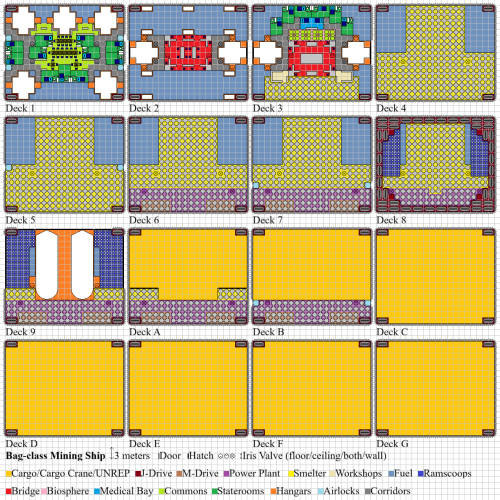
The bottom seven decks are mostly one giant cargo bay. The official deck plan takes advantage of E-hex: decks 1 through 9 are intended for crew to move about, but decks A through G generally are not (though the primary drive engineering space extends through decks A and B), with raw ore and raw material sorted by the cargo crane. Right above deck A is the hangar for two launches, then 5 decks of mostly smelter. Most of the non-engineering crew rarely leaves decks 1 through 3 while aboard ship. Deck A includes transfer machinery to load ore up to the smelter and raw materials down from the smelter, as well as smaller transfer machinery routing to intakes on deck 9 for when the UNREP system is transferring fuel instead. Deck 3 has two small workshops to assemble raw materials into replacement parts for the ship as needed.
The smelter, power plant, and maneuver drive are open to each other in one large multi-deck engineering space. Two engineering lift shafts span from deck B through deck 6 - the span of the power plant and maneuver drive - while two others span from deck 1 through the launch hangar on deck 9. The Sacks are a bit awkward to map to individual decks, as they span two decks but most of their volume is "between" decks; the Sack hangars are designed to accommodate this, with 5 docking on the Bag's top and 2 docking more traditionally at the sides. The side hangars are larger to facilitate maintenance; which Sacks dock here is typically rotated between month-long deployments. Between the hangars and judiciously spaced airlocks, there is at least one way to get off the ship on every other deck from 1 through B.
A Bag is a place where Sack crews can take long rests between week-long deployments. Normal gravity, automation to a degree considered standard, and mostly a lack of duty are sufficient to aid recovery. Extensive commons and customizable biosphere food manufacturing assist with this, as does the medical bay - which, if the crew does maintain the steady operations needed for best profitability, has excess capacity and sometimes gets up to manufacturing recreational drugs.
The bridge is a two-deck affair. The upper deck is sometimes known as the "tourist bridge" with consoles for general use by non-core ship crew. Multiplayer games are a common use, particularly during jump, to the point that it is an unstated rule that such games may only be played during jump (aside from test runs to make sure new games run acceptably). The lower deck is where the core business of running the ship happens, as well as hosting the main portion of the ship computer; the seats here tend to be reserved to specific crew.
Class Naming Practice/s: As with many civilian ships that have been produced for a long time, there is no set pattern to Bag names. Unlike Sacks, all known examples have proper names that were picked up at some point.
Selected Variant Types & Classes[edit]
1 Representative Mining Vessel (GJ) Classes[edit]
References[edit]
| This article has metadata. |

|
This ship was designed using Mongoose 2nd ship design rules.
|
- Author: Adrian Tymes
- ↑ Timothy B. Brown. Fighting Ships (Game Designers Workshop, 1981), 10.
- ↑ Timothy B. Brown. Fighting Ships (Game Designers Workshop, 1981), 10.