Keyhole class Observatory Ship
| Keyhole class Observatory Ship | |
|---|---|
 Keeping an eye on star systems. | |
| Type: SI Surveillance Scout | |
| Category | ACS |
| Size | 1,800 Tons |
| Hull Configuration | Sphere Hull |
| Streamlining | Streamlined Hull |
| Tech Level | TL–13 |
| Engineering | |
| Computer | Model/3 with extra capacity |
| Jump | J-1 |
| Maneuver | 1 G |
| Armaments | |
| Hardpoints | 18 |
| Accommodations | |
| Staterooms | 0 |
| Personnel | |
| Crew | 74 |
| Officers | 3 |
| Enlisted | 65 |
| Marines | 6 |
| High/Mid Passengers | 0 |
| Payload | |
| Cargo | 48.5 Tons |
| Fuel tank | 0 Tons |
| Construction | |
| Origin | Third Imperium |
| Manufacturer | various |
| Year Operational | 688 |
| End of Service | Examples still operate post-Collapse |
| Price | |
| Cost | MCr1,898.6. MCr1,708.74 in quantity. |
| Architect fee | MCrAdrian Tymes |
| Statistics | |
| Quick Ship Profile | SI-TS11 |
| Images | |
| Blueprint | Yes |
| Illustration | No |
| Source | |
| Also see | Survey Vessel |
| Canon | Published, fan design |
| Era | Third Imperium |
| Reference | EXTERNAL LINK: MGT Forums |
| Designed with Mongoose Traveller High Guard rules, but portable to other versions. | |
The Keyhole class Observatory Ship is a noncombatant starship.
- It is a paramilitary ship, and a a Surveillance Scout, which might qualify as a Survey Vessel if not for its primarily military application.
- Two very similar versions are known to Charted Space: one TL-13, one TL-10. This article mainly discusses the TL-13 version.
Description (Specifications)
Modern TL-13 Keyholes are useful anywhere where long-term thorough system-wide or wider survey is desired. This can be a recently or soon-to-be colonized system (especially where a thorough catalog of the asteroid belts is desired for later mining), a secure system (where two Keyholes will typically be deployed in the orbit of an outer gas giant, for redundancy and to give a long baseline for a synthetic aperture, at 120 degrees before and after so as to let the gas giant sweep debris away from the Keyholes into its L4 and L5 points, monitoring primarily in-system traffic), a system to be put under observation (such as a suspected pirates' nest, which gets the same two-Keyhole deployment), or one parsec in a long line (such as Project Longbow, though even after Longbow's revelation it was still classified whether any Keyholes had taken part, leading to speculation that some had been and were still on station).
They are designed to see without being seen. Their greatest visibility comes every 12 weeks, when resupply ships come by for crew rotation, and even then it is preferred their resuppliers come with stealth jump to minimize the chance of detection (Keyholes operate well beyond 100 diameters of any nearby gravity wells, so jumps can be made straight to their positions). Keyholes are unarmed, their jump engines being more about defense than transport: if attacked, standard practice is to jump to the safest spot within a parsec (usually in orbit around a world expected to be friendly).
Plotting and re-plotting these jumps gives the astrogator something to do: on most 12 week rotations, the pilot and astrogator are otherwise utterly bored, though it is common for one or both to pick up steward skills. It is not unknown for the officers to pick up piloting and astrogation among them, and run a rotation without dedicated pilots or astrogators, specifically to avoid the problems that bored hands can cause. Similar thinking is why modern Keyholes did away with the medic position once autodocs became available. Most of the crew is divided into 3 shifts of 1 officer (the captain, first officer, or second officer), 2 marines, and 20 scientists each. The engineers and mechanic work whenever needed, though good engineers will try to arrange their daily duties to be completable within a shift, only leaving undone those things able to wait until the next day.
Keyholes, despite their civilian staffing levels and academic crew bias (not to mention mild luxury in the form of single occupancy staterooms, with attendant commons space), are primarily military assets. Their high price tag means the only non-government owners are megacorporations, and even they use few of these. Sabotage, or merely hostile access of data, are well known threats, but a minimal complement of marines keeps these at bay. Many rotations report the marines more often resolving quarrels between the scientists, and it has become common to value conflict resolution above gunnery skills in marines being considered for a Keyhole rotation, though Imperial laws require even these marines to be able to shoot straight (if only so they will not accidentally pierce an airlock in an emergency). Typically only the marines and officers will be armed, and then only during their shifts (or if boarding actions seem imminent). That the bulk of the crew is people in uniform paid to stargaze all day is inescapable, and is often blamed for perceptions of lax discipline, even if the scientists spend most of their time on shift looking for and at planets, comets, and ships.
Image Repository
Not available at this time.
General Description & Deck Plans
- Deck Plans for this vessel.
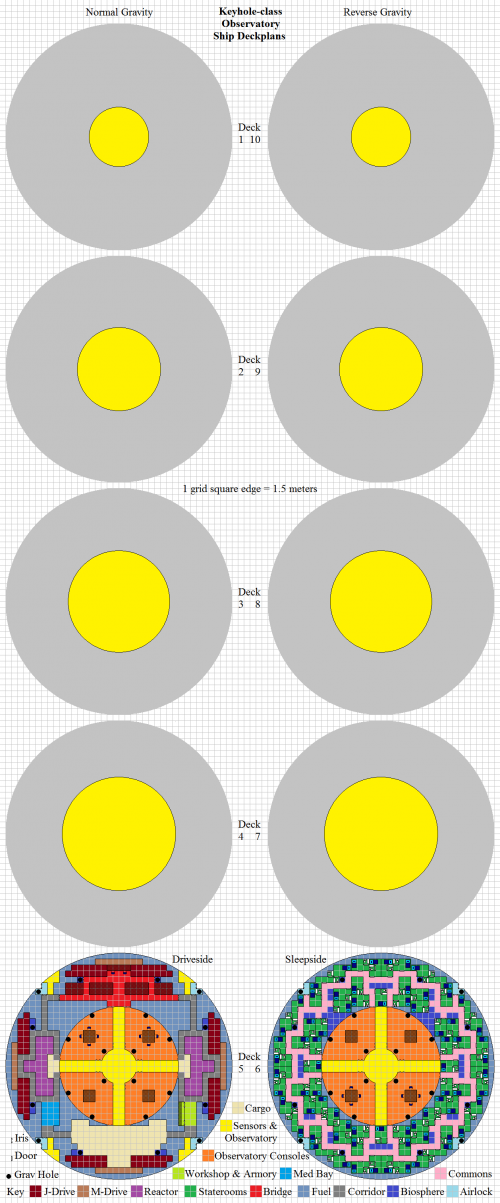

These Deck Plans reflect the TL-13 version, though the TL-10 version does not differ much.
Basic Ship Characteristics
Following the Imperial Navy and IISS Universal Ship Profile and data, additional information is presented in the format shown here. [1] Characteristics are given for the TL-13 version; the TL-10 version has the same except where noted.
| Basic Ship Characteristics [2] | ||
|---|---|---|
| No. | Category | Remarks |
| 1. | Tonnage / Hull | Tonnage: 1800 tons (standard). 25200 cubic meters. Streamlined Cylinder Hull.
|
| 2. | Crew | Crew: 1 Pilot, 1 Astrogator, 2 Engineers, 1 Mechanic, 60 Scientists, 6 Marines, 3 Officers. |
| 3. | Performance | Acceleration: 1-G maneuver drive installed.
|
| 4. | Electronics | Model/3 ship's computer with extra capacity distributed throughout the ship. |
| 5. | Hardpoints | 18 hardpoints, all unused. |
| 6. | Armament | None. |
| 7. | Defenses | None. |
| 8. | Craft | None. Vacc suits required for EVA (extra-vehicle activity). Rescue Balls for crew escape unnecessary and not carried. |
| 9. | Fuel Treatment | It is not equipped with a fuel purification plant or fuel scoops. |
| 10. | Cost | MCr1898.6. standard (no architect's fees, having been amortized long ago). MCr1708.74 in quantity. |
| 11. | Construction Time | 48 months standard, 36 in quantity.
|
| 12. | Remarks | A stargazer's dream military posting. |
History & Background (Dossier)
Keyholes are named for an ancient Terran observation satellite class, the first examples dating back to a few years prior to their first manned orbital spaceflight. The chain of provenance to modern Keyholes is disputed, but the marketing claims continue. It is known that the older TL-10 version dates back to the Interstellar Wars, and the design has not changed much even with the introduction of advanced technology.
In 688, a TL-13 update to the venerable TL-10 Keyhole design was announced. Officially this was to celebrate Margaret I's ascension to Empress; the general consensus is that the design was about ready for public disclosure (having been worked on for over a decade by a collection of Imperial naval architects, most of whom had served on Keyholes) and was just looking for something to tie the announcement to. That said, the marketing campaign tied to its release made good use of juxtaposing images of the Imperial Palace (and, eventually, the Consortium Trinary) with Keyholes.
Despite being such an ancient design, they are mostly only used by the Third Imperium and Solomani Confederation (and their successors; going back in time, the TL-10 version was also used by the Terran Confederation as well as the Second Imperium and its successors, including eventually the Third Imperium and Solomani Confederation), and have rarely (officially) been used by either polity against the other. This, more than anything, explains the lack of specific counter-Keyhole doctrine in any major navy's guidebook.
Class Naming Practice/s & Peculiarities
Ship Interior Details: A Keyhole consists of a spherical main observatory, essentially an airlock left open to vacuum when in use, with 4 wedge-shaped work areas - one for a group operating the spinal-mount-like main telescope and anything coaxially mounted with it, two for groups operating smaller instruments housed within the observatory sphere, and one for a group operating the ship's sensors - separated by gaps for the instruments to traverse through, all surrounded by a ring with the rest of the ship's systems.
Deck plans that divide the main observatory into traditional decks are available, but the only decks of note are the two crew decks: Driveside (deck 5) with most of the ship's systems, and Sleepside (deck 6) with the staterooms. Gravity is along a plane between the two crew decks; one can walk through "grav holes" between the decks on a gravity plane that curves over the edge. While the airlocks, observatory, bridge, and armory are accessible through iris valves in bulkheads, the rest of the crew decks are fairly open. In particular, most of the biosphere takes the form of quickly-fruiting, readily-harvestable plants (output adjustable based on crew preferences) mixed in with the crew commons that wind through the staterooms, poking up behind some of the grav holes for access on Driveside as well.
Oddly, Keyholes are rarely manufactured by megacorporations for sale to the Imperium, but instead usually directly commissioned by the Imperial Navy, or whatever other entity wishes to use them. This has caused some to say they are made by the Navy for the Navy, moreso than most military ship or paramilitary ship classes.
Keyholes are numbered, not named. Officially, the first TL-10 Keyhole was numbered 1 greater than the estimated number of "Key Hole" Terran observation satellites ever deployed by the original Keyhole program and its successors, and a consistent count has been kept through the entirety of the Second Imperium and Long Night, as well as the Third Imperium so far (and, eventually, the Fourth Imperium). This is a staggeringly great claim to prove, though what scant evidence is available suggests it could possibly be true - despite manufacture by two mostly-antagonistic factions (the Solomani Confederation and the Third Imperium) as well as unrelated actors (the occasional megacorporation).
Selected Variant Types & Classes
References & Contributors (Sources)
| This article has metadata. |

|
This article is missing content for one or more detailed sections. Additional details are required to complete the article. You can help the Traveller Wiki by expanding it. |
- Marc Miller, Frank Chadwick, John Harshman. High Guard (Game Designers Workshop, 1980), 20-37. (Design Sequence Used)
- EXTERNAL LINK: An Alphabet of Ships
- Traveller Wiki Editorial Team
- Author & Contributor: Adrian Tymes
- ↑ Timothy B. Brown. Fighting Ships (Game Designers Workshop, 1981), 10.
- ↑ Timothy B. Brown. Fighting Ships (Game Designers Workshop, 1981), 10.