Starino class Modular Orbital Station
| Starino class Modular Orbital Station | |
|---|---|
| Type: WOS Orbital Station | |
| Category | ACS |
| Size | 1,300 Tons |
| Hull Configuration | Planetoid Hull |
| Streamlining | Planetoid Hull |
| Tech Level | TL–14 |
| Engineering | |
| Computer | Model/2/bis |
| Jump | J-0 |
| Maneuver | 0 G |
| Armaments | |
| Hardpoints | 13 |
| Accommodations | |
| Staterooms | 88 |
| Personnel | |
| Crew | 4 |
| High/Mid Passengers | 84 |
| Payload | |
| Cargo | 39.75 Tons |
| Fuel tank | 2 Tons |
| Construction | |
| Construction Time | 10 Months |
| Origin | Julian Protectorate |
| Manufacturer | Menderes Corporation |
| Year Operational | 814 |
| Price | |
| Cost | MCr294.74 |
| Statistics | |
| Quick Ship Profile | WOS-NP00 |
| Universal Ship Profile | WOS-E1900P |
| Images | |
| Blueprint | Yes |
| Illustration | No |
| Source | |
| Also see | Space Station |
| Canon | Published, non-canon design |
| Designer | Adrian Tymes |
| Design System | Mongoose Traveller |
| Era | Third Imperium |
| Reference | Fan: Adrian Tymes |
The Starino class Modular Orbital Station is a TL–14 civilian space station.
Description[edit]
A Starino can be thought of as a space station version of a yacht. It is a modular casino-hotel, intended more to serve in-system traffic than starships but often pressed into service to entertain starfaring travellers too. It lacks significant onboard fuel storage or refining, intended to contract out for delivery of refined fuel as needed. Each individual Starino is intended to house no more than 84 passengers and 4 crew, but Starinos can dock together via pairs of airlocks on the Diamonds deck to expand capacity; such docking favors pairing the casino sides together when possible. They are most often found around Non-industrial worlds: smaller populations do not usually generate enough traffic to sustain them (especially if spare parts must be imported), while larger ones are more efficiently served with larger, more customized installations.
A Starino's crew (who are provided with slightly luxurious staterooms, compared to most stations) is rarely "on shift", but instead spends most of their time overseeing the station's automation, which performs almost all passenger-contact duties: cooking, cleaning, food delivery, running the casino and shops, concierge, information distribution, traffic control and general sensor operation, and so on. The station's computer is optimized to run a specialized virtual crew program dedicated towards this purpose, with extra bandwidth to interact directly with several passengers at once. The two steward positions are primarily psychologists, helping the machines figure out and anticipate particulars of sophont behavior that TL 14 artificial intelligences are not good at. Exact crew duties shift with the passengers; for instance, a Starino that operates primarily as a discrete augmentation shop is well served to have a sophont medic, rather than relying on the basic medical capability provided by the virtual crew software.
Despite being the feature the class is named for, whether the casino is used for gambling, or at all, depends on local tastes. Some refit it into a Ship Theater usually showing either prerecorded productions, or mostly-pregenerated content with some interactivity mediated by what amount to virtual crew actors and narrators. There are worlds of a more militaristic bent which have one or a few Starinos with casinos refitted into virtual training areas, though it should be said that the luxury these "warriors" are otherwise pampered with during their "training" speaks to the very low amount of actual combat they will ever face; in truth, they are tourists or idle wealthy in all but name.
General Description & Deck Plans[edit]
- Deck Plans for this vessel.
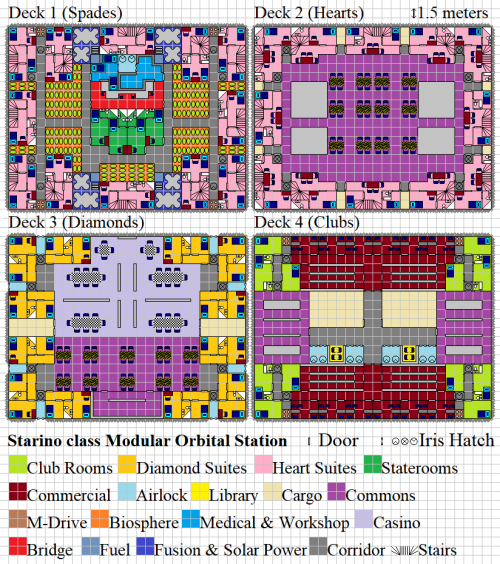

Basic Ship Characteristics[edit]
Following the Imperial Navy and IISS Universal Ship Profile and data, additional information is presented in the format shown here. [1]
| Basic Ship Characteristics [2] | ||
|---|---|---|
| No. | Category | Remarks |
| 1. | Tonnage / Hull | Tonnage: 1300 tons (standard). 17550 cubic meters. Planetoid Hull.
|
| 2. | Crew | Crew: 1 Administrator, 1 Mechanic, 2 Stewards. 1 virtual Medic, 1 virtual Sensor Operator, and 3 virtual Stewards provided via software. |
| 3. | Performance | Acceleration: 0-G station-keeping maneuver drive installed.
|
| 4. | Electronics | Model/2/bis ship computer, specialized for Virtual Crew rather than Jump Control. |
| 5. | Hardpoints | 13 hardpoints in theory. In practice, few of this class are armed. |
| 6. | Armament | None. |
| 7. | Defenses | None. |
| 8. | Craft | None. Vacc suits required for EVA (extra-vehicle activity). Rescue Balls for crew escape normally carried. |
| 9. | Fuel Treatment | It is not equipped with a fuel purification plant or fuel scoops. |
| 10. | Cost | MCr294.74 (no architect's fees, those having long since been paid). MCr265.266 in quantity. |
| 11. | Construction Time | 10 months standard, 6.5 in quantity. |
| 12. | Remarks | A prefabricated space station combining the functions of a hotel and casino, to entertain a small but nonzero traffic of high passengers. |
History & Background (Dossier)[edit]
The Starino is an offshoot of development efforts involved in setting up the Saeghvung-Turley-Exile_Run starting in 814. TL-14 was new at the time to the Menderes Corporation, which wished to bid to assist with the construction of these Deep Space Stations. An underserved but extant target market - high passenger facilities for Non-industrial worlds, too small to justify custom designs - was selected as representative of the context of space stations intended for long-term operation away from substantial industrial resupply. As a training effort, the project to create the design was deemed largely successful.
As this was not a major market, no significant effort was made to protect the intellectual property after the project was completed. As has happened from time to time, this lack of protection allowed the blueprints and parts specifications to spread freely throughout Charted Space, particularly in human and Vargr dominated regions as the class was designed primarily to appeal to those two sophonts. It is suspected that the majority of Starinos have been manufactured without notice to the Menderes Corporation, though Menderes will manufacture replacement parts for Starinos regardless of the original station's manufacturer.
Class Naming Practice/s & Peculiarities[edit]
Ship Interior Details: Starinos' decks take the names of suits of Hoyle-class playing cards (Spades, Hearts, Diamonds, and Clubs), as do the living areas: Club rooms (equivalent of a medium residence: little more than a stateroom), Diamond suites (1 medium and 1 high residence, melded together), and Heart suites (1 luxury, 1 high, and 2 medium residences melded together), 12 of each numbered Two through Ten then Jack, Queen, and King. Even the crew staterooms are "Spade rooms", numbered Jack, Queen, King, and Ace. The in-joke of the names refers to poker hands: the extensive automated crew assistance is referred to as Spade Ten (sometimes also Nine through Two); Ace, King, Queen, Jack, and Ten of the same suit form a "royal flush", the highest scoring poker hand possible; thus, the crew and robots together beat out (are more in control of the station than) any combination of passengers - for instance, if some subset of passengers turn out to be pirates intending to rob the station.
The Heart suites are intended as the apex of commonly available luxury. While the layouts slightly differ to cater to different tastes, they each feature a nook where the occupants can gather, and perhaps the height of luxury on a space-limited station is symbolized by the presence of actual stairs (which can flatten into a grav-assisted ramp for those who need it) instead of the usual ladders and lifts. Each Heart suite is spread across two decks, though the upper half (on the Spades deck) is only accessible from within the suite via these stairs. The rest of the Spades deck is usually only accessible to the crew; even patients traveling to and from the medical bay are supposed to be escorted by a crew member, for security.
The medical bay, with quick access to the workshop, is optimized for prosthetics and cloning replacement parts. More than one Starino doubles as a covert augmentation shop: get an augment installed, rest and recover in luxury, and then claim to have just been taking a vacation - a plausible reason to have spent time on a Starino - so no one suspects you of having taken a trip to get augmented. Avoiding complications associated with this is why the medical bay also has direct access to the roof airlock; the official excuse is to facilitate emergency care, should a ship come by in need of medical assistance.
Food logistics are a concern, as on most orbital stations. The station has enough food production to serve the rated single occupancy full capacity. Most food production first goes to the autokitchens under the main biospheres. From there, distribution priority is to the people on the station, then as packaged snacks and meals for sale on the Clubs deck's shops, then as cargo to buffer against times of high traffic or for export.
Most ships dock to an array of docking arms and clamps underneath the Clubs deck. Eight airlock tunnels snake around, switching from ship to ship when passengers signal a request (after making sure no one is in the tunnel). Upon entrance, passengers are automatically greeted, any cargo they wish to deposit taken to the main bays (or special bays on the Hearts deck for Heart suite passengers), and the passengers directed either to the library/waiting area (if they are awaiting more passengers), through the shops to their rooms or, if they are just visiting, the main casino area or one of the rentable offices. (Starinos maintain just enough commercial area that they could qualify as a Class D highport, if they had their own fuel refinery and storage - or if one includes the capacity of locally available fuel refineries and delivery ships. In practice they are almost never a system's main starport, but may count as private Class H Spaceports.)
Class Naming Practices: Starinos are not commonly individually named. Where they are the only one in the system, they are typically referred to as "the Starino". In almost all cases where there is more than one in a system, they will be docked together and collectively referred to as "the Starino". They do have registration numbers when referring to a specific Starino, whether between systems or one of a docked block, becomes necessary.
Selected Variant Types & Classes[edit]
1 Representative Orbital Station (WOS) Classes[edit]
References[edit]
| This article has metadata. |

|
This ship was designed using Mongoose 2nd ship design rules.
|
- Author: Adrian Tymes
- ↑ Timothy B. Brown. Fighting Ships (Game Designers Workshop, 1981), 10.
- ↑ Timothy B. Brown. Fighting Ships (Game Designers Workshop, 1981), 10.