Victoria (SM 1817) (world)

| Victoria/Lanth (Spinward Marches 1817) | |||||||||||||||||||||||||
| Classic Era (1116) | D6D7772-2
| ||||||||||||||||||||||||
| See also | UWP | ||||||||||||||||||||||||
| System Details | |||||||||||||||||||||||||
| Primary | K6 V | ||||||||||||||||||||||||
| Planetoid Belts | 1 | ||||||||||||||||||||||||
| Gas Giants | 2 | ||||||||||||||||||||||||

Victoria does not meet the criteria for any standard classification.
- It is a member of the Third Imperium in the Lanth Subsector of Spinward Marches Sector in the Domain of Deneb.
- This is a "low technology" world with technology competencies well below standard for Charted Space.
- This is a "forbidden" world designated as a Red Zone with an environment, laws, customs, life forms, or other conditions that make it extremely dangerous to visitors. Everyone is forbidden to travel here.
- This world contains an archaeological site with suspected high-tech remnants of the now-vanished Ancients precursor race.
- It is located just off of the Lanth-Ghandi-Dinomn xboat route.
- It lies within the Abyss Rift.
Description (Astrography & Planetology)
Stars
Victoria has a solitary primary star.
- It is an orange main sequence.

Victoria has a solitary primary star. Victoria 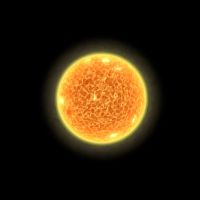
Type Category Mass (Sol) Temperature (K) Luminosity K6 V Main Sequence (Dwarf) 0.69 4100 - 4300 0.27288 Unit Diameter Safe Distance Habitable Zone Jump Shadow M-Drive Limit AU 0.0062 0.0433 0.53 - 0.99 0.62 6.2 Orbit # * * 2 2 6 Remarks None
System Data
The worlds of the system have been surveyed. They consist of:
- The mainworld.
- x4 secondary rocky worlds.
- x1 planetoid belt.
- x2 gas giants.
Mainworld Data
Victoria is a medium size world with a dense, tainted atmosphere. The taint requires an oxygen supply or full sealed environment suit to survive, but exists only at the lower elevations. Above 1000m the atmosphere is safe to breathe.
Mainworld Size (S)
Victoria is a Meso World between 8,800km and 10,400km in diameter. The world has a standard gravity between 0.6G and 0.8G. The horizon will appear about 4.4km away.
Mainworld Atmosphere (A)
Victoria has a pressure of 2.5 or greater atmospheres. A Dense & High Pressure Atmosphere typically requires no survival gear under many conditions. Pressure at or below sea level is too great to support life but the atmosphere may be breathable at higher altitudes. TL–5 or more advanced survival gear is required to settle this world.
Mainworld Hydrosphere (H)
Victoria has 65-75% of its surface covered by liquid water or ice heavily tainted with other substances, which makes it dangerous, corrosive, or toxic. Wilderness refueling will be difficult. Water for the inhabitants needs to be imported and extensively recycled. These worlds may be Hell Worlds.
- The water on the surface may be unsuitable for use or consumption without extensive filtering and purification.
- Refining for fuel may cause issues with shipboard purification plants.
Mainworld Geography and Topography
No centrally held map of the world exists within AAB Library Data records.

(Blank map, predominantly watery world.)
Satellites
Victoria has a single moon, Albert, which is large enough to retain an atmosphere and even appears to have some surface water.
- It orbits once every few weeks.
- It is officially listed as uninhabited, though there have been reports of a stone (or sometimes crystalline) city on the surface.

History and background
The human population of Victoria numbers approximately ten million. The people dwell on high ground, mainly in a region known as the Mesas. There is no world government: laws, government, and technology vary from area to area.
Balloons and dirigibles, sometimes powered by hand-cranked propellers, have made travel possible between areas previously cut off by low ground. In addition to the City of Victoria, the other major settlement on the planet is Sarik Gi. While proper permits might allow visits to Victoria, such permits include strict clauses about trading metal or metal goods to the locals, and specifically prohibits access to Victoria’s moon, Albert. Permits make it perfectly clear that lethal force may be used without warning against any vessel approaching the moon.
Point of Interest: Orbital Bombardment Evidence
Approximately 300,000 years ago Victoria appears to have been subject to a devastating bombardment from space by a variety of weapons, most notably asteroids. The bombardment resulted in a number of immense craters, some of which are today seas or great lakes; the Mesas also appear to have been created by the bombardment.
References and contributors
- Marc Miller. The Spinward Marches (Game Designers Workshop, 1979), 22-23.
- Marc Miller. The Spinward Marches Campaign (Game Designers Workshop, 1985), 18-19.
- Marc Miller. Imperial Encyclopedia (Game Designers Workshop, 1987), 94-100. (UWP only)
- Rob Caswell. "Domain of Deneb: Sector Data." MegaTraveller Journal 3 (1992): 47-58. (UWP only)
- Martin Rait. "Spinward Marches Pre-Imperial History." Meshan Saga 07 (1988): 13-14.
- Dave Nilsen. The Regency Sourcebook (Game Designers Workshop, 1995), 42. (UWP only)
- Martin Dougherty, Neil Frier. Behind the Claw (Steve Jackson Games, 1998), 86.
- Mike West. The Spinward States (Avenger Enterprises, 2008), 104. (UWP only)
- Martin Dougherty. The Spinward Marches (Mongoose Publishing, 2008), .
- Martin Dougherty. Behind the Claw (Mongoose Publishing, 2019), 71-72.
- ↑ "Jump Map API" and map location from Travellermap.com