Lance Marcus class Scout
| Lance Marcus class Scout/Courier | |
|---|---|
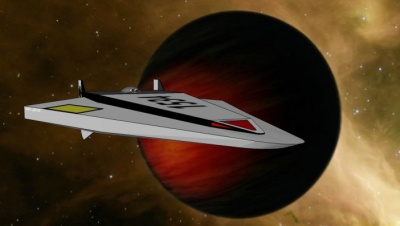
 A Marcus class Scout/Courier surveying a planet. | |
| Type: SC Scout/Courier | |
| Category | ACS |
| Size | 100 Tons |
| Hull Configuration | Wedge Hull |
| Streamlining | Lifting Body Hull |
| Tech Level | TL–15 |
| Engineering | |
| Computer | Model/5 |
| Jump | J-2 |
| Maneuver | 2 G |
| Armaments | |
| Hardpoints | 1 |
| Accommodations | |
| Staterooms | 0 |
| Personnel | |
| Crew | 2 |
| Officers | 1 |
| Enlisted | 1 |
| High/Mid Passengers | 0 |
| Payload | |
| Cargo | 22.0 Tons |
| Fuel tank | 0 Tons |
| Construction | |
| Origin | Third Imperium |
| Year Operational | Unknown |
| End of Service | Still in active service. |
| Price | |
| Cost | MCr73.38 |
| Architect fee | MCrWill Richards |
| Statistics | |
| Quick Ship Profile | SC-AL22 |
| Images | |
| Blueprint | Yes |
| Illustration | Yes |
| Source | |
| Also see | Scout Vessel - Scout/Courier |
| Canon | Published, fan design |
| Era | 1117 |
| Reference | None |
| Starships are designed with the Classic Traveller format, using High Guard. | |
The Lance Marcus class Scout/Courier is an exploratory starship.
- It is a paramilitary ship and a Scout Vessel.
- It is sometimes notated as a Marcus class Scout.
Description (Specifications)
It is a vessel with 1-G and J-1 performance with a streamlined TBD hull.
- It carries light armament and a defensive suite.
- It ordinarily carries no subcraft, no ship's vehicles, and drones only when needed.
- It has a # sophont crew and # marines.
The Marcus Class Scout is a TL-15 design capable of Jump-2, 2 G acceleration and can carry 3 passengers, has a robotic support crew and one living pilot. The savings in space and fuel from traditional scout curriers allows the ship to accommodate 22 tons of cargo space.
Lance Marcus was an explorer who died while investigating a newly discovered Ancients facility. Marcus was an avid angler and loved floating his ship on the surface of on a ocean at every world he visited that had one, for relaxation purposes. Thus, the architect, a friend of his, added the fins to the ship to give it better characteristics while skimming along the surface of an ocean.
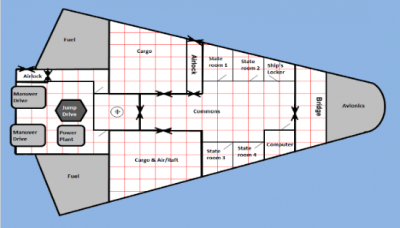
Based on the earlier Intrepid class[1] Scout/Courier hull design, the Marcus Class has four staterooms, an Air/Raft, and a sophisticated model 5 computer. There are two airlocks on this class, amid ships for ship to ship transfers, and the stern airlock which has an extendable ramp underneath it for use planetside.
Image Repository
- A Marcus class Scout monitoring a rogue brown dwarf system.

General Description & Deck Plans
- The basic Deckplan for a Marcus class Scout.

Basic Ship Characteristics
Following the Imperial Navy and IISS Universal Ship Profile and data, additional information is presented in the format shown here. Tonnage on the universal ship profile is shown in kilotons (...thousands of tons) where necessary. [2]
| Basic Ship Characteristics | ||
|---|---|---|
| No. | Category | Remarks |
| 1. | Tonnage / Hull | 100 tons. The hull is streamlined.
|
| 2. | Crew | The scout/courier requires a crew of one, assuming the duties of pilot and engineer.
|
| 3. | Performance | It mounts jump drive-2, maneuver drive-2, and power plant-4, giving performance of jump-2 and 2-G acceleration. A 24-ton fuel tank provides fuel for the power plant and provides sufficient fuel for one Jump-2.
|
| 4. | Electronics | Adjacent to its bridge is a Model/5 computer. |
| 5. | Hardpoints | x1 hardpoint. |
| 6. | Armament | x1 Triple turret with its fire control is installed on the ship's hardpoint, but no weaponry is mounted. [3]
|
| 7. | Defenses | When the turret is filled with weaponry, a sandcaster is typically fitted. |
| 8. | Craft | x1 Air/raft is carried in the starboard cargo bay/hangar within the ship. |
| 9. | Fuel Treatment | It is equipped with purification and fuel scoops. |
| 10. | Cost | The ship costs MCr 73.38. |
| 11. | Construction Time | It typically takes nine months to build. [4] |
| 12. | Remarks | Other Equipment:
|
History & Background (Dossier)
Just before the Fifth Frontier war began the IISS realized they needed a more modern scout ship to perform certain duties. The risk of having a fully modern ship which was not necessarily repairable at a lower tech facility was outweighed by the need for improved reconnaissance. working with the Naval Admiralty, the Scout service was able to complete the design of the ship after the war had ended. The scouts quickly began deploying these ships to remote areas so the could keep a better watch on the Zhodani and Vargr. Additionally, a robotic complement for the crew was added to help alleviate the workload on the crews. Allowing them to concentrate on reconnaissance and less on ship's maintenance and operation.
Class Naming Practice/s & Peculiarities
Named after Scouts who have made major discoveries or more usually, just numbered, as they exist in the thousands. the Marcus class Scout has been well received by its crews who were accustomed to lower tech level scout couriers. one peculiarity is the ship's fuel scoops and filtering system which doubles as a water jet propulsion system for the craft. This system of refueling manages to serve two purposes, to provide fuel from remote locations and to help move the ship while it is floating on the surface of an ocean. Normally, scout ships would just use their maneuver drives on very low power. However, this caused problems with giving away the ship's position. By utilising the fuel scoops and filters as a electrically powered water jet propulsion system the crew could maneuver the ship rather easily with little noise or water spray compared to the maneuver drive. one added bonus that the scouts have discovered is the ship can now be used for water sports activities such as skiing, without the fear of killing the skier with the engine exhaust. The distinctive fins on this ship can also be used while maneuvering on an ocean surface, but also while in the atmosphere of a planet giving it an improved agility rating.
Selected Variant Types & Classes
References & Contributors (Sources)
| This article has a secret. |
- Marc Miller, Frank Chadwick, John Harshman. High Guard (Game Designers Workshop, 1980), 20-37. (Design Sequence Used)
- Author & Contributor: Will Richards
- ↑ Marc Miller. Snapshot (Game Designers Workshop, 1979), 16.
- ↑ Timothy B. Brown. Fighting Ships (Game Designers Workshop, 1981), 10.
- ↑ Marc Miller. Starships (Game Designers Workshop, 1977), 19.
- ↑ Marc Miller. Starships (Game Designers Workshop, 1977), 19.