Difference between revisions of "Train"
| Line 2: | Line 2: | ||
A [[Train]] is a kind of [[vehicle]] often used for mass transit of [[passenger]]s and/or [[cargo]]. | A [[Train]] is a kind of [[vehicle]] often used for mass transit of [[passenger]]s and/or [[cargo]]. | ||
* On many worlds, they are an important part of transportation [[infrastructure]]. | * On many worlds, they are an important part of transportation [[infrastructure]]. | ||
| − | * While many sophonts picture rains as a wheeled and rail technology, many other variants are possible including rubberized tires (...Land Trains), cable- | + | * While many sophonts picture rains as a wheeled and rail technology, many other variants are possible including rubberized tires (...Land Trains), cable-pulley systems (...cable cars, funiculars, etc.), trackless trains, pressurized air systems (...Atmospheric Trains), trams, trolleys, monorails, maglev systems, and even later: the [[Grav Train]]. |
== Description ([[Specifications]]) == | == Description ([[Specifications]]) == | ||
Revision as of 18:26, 15 July 2019

A Train is a kind of vehicle often used for mass transit of passengers and/or cargo.
- On many worlds, they are an important part of transportation infrastructure.
- While many sophonts picture rains as a wheeled and rail technology, many other variants are possible including rubberized tires (...Land Trains), cable-pulley systems (...cable cars, funiculars, etc.), trackless trains, pressurized air systems (...Atmospheric Trains), trams, trolleys, monorails, maglev systems, and even later: the Grav Train.
Description (Specifications)
A train is a form of transport consisting of a series of connected vehicles that generally runs along a railroad track to transport cargo or passengers. The word "train" comes from the Old French trahiner, derived from the Latin trahere meaning "to pull" or "to draw."
Image Repository
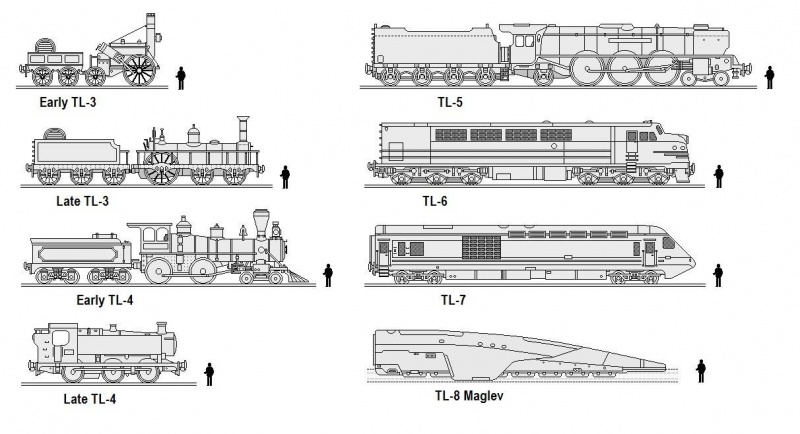
- Trains are an important part of transportation infrastructure on many worlds.

Common Types of Network
- Land Trains - linked ground vehicles following a set route such as a paved highway.
- Railroad Networks - linked vehicles following a network made up of parallel rails.
- Monorail Systems - linked vehicles following a network made up from a single rail.
- Maglev Networks - linked vehicles following a network
- Gravlev Networks - gravitic vehicles, typically employing early lifter technology and utilizing flat, smooth prepared routes to maximize efficiency.
- Hyperloop Systems - linked pressurized vehicles operating within vacuum tubes.
- Skytrains - trains of linked aerial gravitic vehicles.
History & Background (Dossier)
Trains tend to be a pillar of transportation infrastructure for sophont societies during the TL:1-9 Foundational Period or Ur-Period of development. By TL:10-12, the technology becomes increasing supplanted and replaced by gravcraft. Grav trains are a viable technology and some societies have developed the technology viably.
Expected Train Development Sequence
MACRO LEVEL:
- Steam Locomotive → Funicular Train → Cog Locomotive → Internal Combustion Train → Diesel Train → Electric Train → Land Train → Subway Train → Light Rail Locomotive → High Speed Locomotive → Atmospheric Train → Monorail Train → Maglev Train → Hover Train → Grav Train
Foundational Age Societies
The first trains generally run on rails, tracks, roads, or prepared transit ways.
| Technological Period: TL:1-9 and Tech-Name: Ur-Tech | ||
|---|---|---|
| Common Characteristics: TBD, etc. | ||
| Tech Epoch | TL-Range | Remarks |
| Tool Making Epoch | TL:1-3 | During the end of this period, many sophont societies develop external combustion and the first viable, high beastpower develop the first steam engines. Combined with metallurgy skills, rails and large engines can be cast, which result in continental train networks where resources are available. |
| Division of Labor Epoch | TL:4-6 | Increasing mastery of internal combustion engines result in more powerful diesel trains including diesel locomotives which can easily make transcontinental freight runs. Intermodal cargo systems increase the reach and flexibility of cargo networks. Land trains and even hover trains on some worlds become viable. Most large bodies of waters are dominated by maritime shipping options. |
| Processor Epoch | TL:7-9 | Electronics and electric trains become increasing more capable and superconductor and early gravitic control technology allow high speed trains and maglev movers. Lower aircraft fuel costs and competing mass transit systems begin the decrease the reach and desirability of train systems. |
Interstellar Age Societies
Gravitic trains have little to no need for preprepared infrastructure.
| Technological Period: TL:10-18 and Tech-Name: Stell-Tech | ||
|---|---|---|
| Common Characteristics: TBD, etc. | ||
| Tech Epoch | TL-Range | Remarks |
| Gravitics Epoch | TL:10-12 | Mastery of gravity control technologies allow for the first grav trains, which begin to supplement earlier electro-mechanical technologies on worlds that can afford them. City Minds, AI controllers, allow city and even country-wide traffic networks, with very low accident rates. |
| Biologicals Epoch | TL:13-15 | Fewer and fewer cities build widespread transportation infrastructure networks and the cost of gravcraft decreases. Within arcologies, people movers and internal mass transit networks are quite common. Grav trains still serve a very useful and valued place on such worlds, connecting arcologies. |
| Artificials Epoch | TL:16-18 | No one knows where the future will go with mass transit. Some cities have posited that planetwide gravitic control networks will become possible rather than a combination of continental travel networks supplemented by air/rafts, G-carriers, and Grav Trains. |
References & Contributors (Sources)

|
This page uses content from Wikipedia. The original article was at Train. The list of authors can be seen in the page history. The text of Wikipedia is available under the Commons Attribution-ShareAlike 3.0 Unported License. |

|
This article is missing content for one or more detailed sections. Additional details are required to complete the article. You can help the Traveller Wiki by expanding it. |
- TBD
- TBD
- TBD
- TBD
- Traveller Wiki Editorial Team
- Author & Contributor: Lord (Marquis) and Master Scout Emeritus Adie Alegoric Stewart of the IISS
- Author & Contributor: Lord (Marquis) and Master of Sophontology Maksim-Smelchak of the Ministry of Science