Packet Ship
| Capital Ship Combatants | Escort Combatants | Military Smallcraft | Support Ships | |||||||
|---|---|---|---|---|---|---|---|---|---|---|
| Battleship | Cruiser | Carrier | Destroyer | Escort | Frigate | System Defense Boat | Fighter | Assault Transport | Smallcraft | Auxiliaries |
| Commercial Mercantile Ships | Non-Mercantile Commercial Ships | Non-Commercial Ships | Civilian Smallcraft | Highports & Satellites | ||||||
|---|---|---|---|---|---|---|---|---|---|---|
| Merchant | Liner | Transport | Commercial Industrial | Commercial Ships | General | Research | Private | Auxiliary | Orbital Complexes |
Satellites |
Packet Ship: A Packet Ship primarily carries passengers on unscheduled routes. [1]
- It is a starship supraclass.
- The Supraclass designation is also known as Ship Mission, Ship Mission Code, Mission, or Ship Hull Designation.

Please refer to the following AAB Library Data for more information:
Starship:
- Starship User Types
- Ships by Function
- Advanced Ship Classifications
- Ship Mission Code / Supraclass
- Ship Type Code / Superclass
- Ship Class Code / Class
- Model (TL)
- Bloc (Lot)
- Basic Ship Classifications
- Speed of Travel
Description (Specifications)
Packet Ship conduct similar missions as Liners and Courier Vessels. They are generally understood to perform unscheduled missions where Postal Routes do not exist. Most are equipped with Mail Vaults and secure Staterooms. [2]
- Vessels such as Armed Packet (UF-CA33) perform unscheduled passenger service for those in a hurry. The crew can be trusted, but these little ships can still find themselves jumping into harm's way. [3]
- Generally, packet trade is any regularly scheduled cargo, passenger, and X-mail trade conducted by space or starship. The ships are called "packet boats" as their original function was to carry X-mail. "Packet" can mean a small parcel but, originally meant a parcel of important correspondence or valuable items, for urgent delivery. [4]
General Definition
Packet Ships are a class of small merchantmen generally in the 200 to 400 ton range designed to fill the gaps left by the trade lanes that follow the x-boat routes. They may be operated by planetary governments, private individuals, or corporations, they may even be assigned by a subsector duke concerned with developing the economy of their subsector. [5]
- Their purpose is to carry X-mail, passengers, and high value cargo quickly from the trade hubs to the more distant worlds within a subsector, worlds often economically unreachable with smaller jump number drives. [6]
- A packet ship will typically be fully atmospheric capable, have a 2-3G drive for normal space operation and a Jump-3 or 4 drive for FTL travel. [7]
- In order to qualify for mail contracts and planetary subsidies a frontier packet ship is routinely armed and is thus designated as an armed packet. [8]
- Originally packet ships were often military surplus couriers or dispatch ships, either purchased or leased for civilian use. They have proven so useful for stimulating the frontier economy that purpose built packets have all but replaced the older military designs. [9]
Image Repository
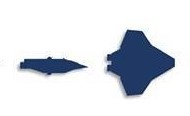
- A schematic of the Imperial Armed Packet featured on playing cards used by Imperial Marines.
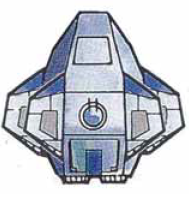
- A top down image of the most common Imperial Armed Packet in a common livery.


Strategy & Tactics (Doctrine)
Packet Ships perform high priority missions to deliver very high value cargo or passengers to sensitive destinations. They generally focus on high value passengers who carry top secret messages in areas where the fear of electronic intercept is a worry. Packet ships usually travel at high burn to make themselves difficult to intercept. Many use jump shadows or other masking features to minimize detection. [10]
Supraclass Roles
Packet Ships typically serve the following roles:
- Armed Packet
- Armed Packet Ship
- Dispatch Ship
- Express Packet Boat
- Packet
- Packet Boat
- Packet Liner
- Packet Ship (Namesake)
Supraclass Archtypes
History & Background (Dossier)
A number of kinds of Communication Vessels exist, and the Packet Ship has come to occupy a ship mission niche not occupied by X-Boats, Courier Vessels, Relay Vessels, or other kinds of ships that perform communication duties. Packet Ships were once far more numerous before the establishment of the X-boat System in the year 624. [11]
They remain in use as of 1105, but are much less prevalent today. Some Packet Ships such as the Vargr Dhaztuen class Packet Ship or Dhaztuen class Far Merchant are also double-missioned in the same manner as Scout/Couriers. [12]
Selected Variant Types & Classes
Communication Vessel - Packet Ship:
- Type XU class Packet Ship
- Type XUA class Armed Packet Ship
- Type XUV class Packet Boat AKA Type VM class Packet Boat
Ship Summary List
Some of the most commonly used vessels in this role include:
| 1 Representative Packet Ship (XU) Classes | |||||||||||||||||||||||||||
|---|---|---|---|---|---|---|---|---|---|---|---|---|---|---|---|---|---|---|---|---|---|---|---|---|---|---|---|
|
References & Contributors (Sources)

|
This page uses content from Wikipedia. The original article was at Packet_boat. The list of authors can be seen in the page history. The text of Wikipedia is available under the Commons Attribution-ShareAlike 3.0 Unported License. |
|
|
This page uses content from Wikipedia. The original article was at Packet_trade. The list of authors can be seen in the page history. The text of Wikipedia is available under the Commons Attribution-ShareAlike 3.0 Unported License. |

|
This article is missing content for one or more detailed sections. Additional details are required to complete the article. You can help the Traveller Wiki by expanding it. |
- Bob McWilliams. IISS Ship Files (Games Workshop, 1981), TBD.
- Frank Chadwick, John Harshman, J. Andrew Keith, Marc Miller, Loren Wiseman. The Traveller Adventure (Game Designers Workshop, 1983), 152.
- J. Andrew Keith, Marc Miller, John Harshman. Vargr (Game Designers Workshop, 1984), 13.
- Simon Beal. Vargr (Mongoose Publishing, 2009), TBD.
- Marc Miller. T5 Core Rules (Far Future Enterprises, 2013), TBD.
- Tom Mouat, Ian Stead. Traveller Ship Font (Moon Toad Publishing, 2019), TBD.
- Traveller Wiki Editorial Team
- Author & Contributor: Randy Dorman
- Author & Contributor: Robert Eaglestone
- Author & Contributor: Mike Wightman
- Author & Contributor: Lord (Marquis) and Master of Sophontology Maksim-Smelchak of the Ministry of Science
- ↑ Marc Miller. T5 Core Rules (Far Future Enterprises, 2013), 65.
- ↑ Information provided to the library by Maksim-Smelchak
- ↑ Marc Miller. T5 Core Rules (Far Future Enterprises, 2013), 738.
- ↑ Information provided to the library by Maksim-Smelchak
- ↑ Information provided to the library by Mike Wightman
- ↑ Information provided to the library by Mike Wightman
- ↑ Information provided to the library by Mike Wightman
- ↑ Information provided to the library by Mike Wightman
- ↑ Information provided to the library by Mike Wightman
- ↑ Information provided to the library by Maksim-Smelchak
- ↑ Information provided to the library by Maksim-Smelchak
- ↑ Information provided to the library by Maksim-Smelchak