Difference between revisions of "Iron Monarch class Mining Vessel"
(Created page with "{{InfoboxShip |name = Iron Monarch class Mining Vessel |image = Wiki Navy.png |caption = A yacht for belters |tdes = JM |type = Mining...") |
|||
| Line 71: | Line 71: | ||
The class is notable for only requiring a single crew member: one [[astrogator]]. Even this is optional if the ship stays within one system, such as when travelling between a [[mainworld]] and a [[planetoid belt]] in the same system. It has a [[jump drive]] with fuel for two single-parsec jumps as a secondary function, often used for microjumps when it would take more than a week to reach the belt. Everything else is automated: [[pilot]], [[sensor operator]] for prospecting, and [[gunner]]s for mining are all run from the ship's computer, while repair drones tend to what little maintenance is needed when they are not gathering ore or tending to the ship's occupant. There is life support for two - a design compromise spurred in part by the minimum effective scale of certain components that help achieve the luxurious standard of living aboard - but the class's early advertising emphasized a ship for one person. | The class is notable for only requiring a single crew member: one [[astrogator]]. Even this is optional if the ship stays within one system, such as when travelling between a [[mainworld]] and a [[planetoid belt]] in the same system. It has a [[jump drive]] with fuel for two single-parsec jumps as a secondary function, often used for microjumps when it would take more than a week to reach the belt. Everything else is automated: [[pilot]], [[sensor operator]] for prospecting, and [[gunner]]s for mining are all run from the ship's computer, while repair drones tend to what little maintenance is needed when they are not gathering ore or tending to the ship's occupant. There is life support for two - a design compromise spurred in part by the minimum effective scale of certain components that help achieve the luxurious standard of living aboard - but the class's early advertising emphasized a ship for one person. | ||
| − | The living standards approach that of high passage, but the lack of a sophont steward - or indeed, anyone else at all - is widely seen as holding it back somewhat. Even if further software is acquired to help with the [[astrogation]], the sophont [[crew]] still has to do a little bit of work: picking destinations, authorizing mining (taking responsibility for not jumping someone else's claim), coordinating sale of the ore once back at port, and so on. | + | The living standards approach that of high passage, but the lack of a sophont steward - or indeed, anyone else at all - is widely seen as holding it back somewhat. Even if further software is acquired to help with the [[astrogation]], the sophont [[crew]] still has to do a little bit of work: picking destinations, authorizing mining (taking responsibility for not jumping someone else's claim), coordinating sale of the ore once back at port, and so on. That said, most of the owner's time in practice is spent on other tasks such as art. |
=== General Description & Deck Plans === | === General Description & Deck Plans === | ||
| Line 147: | Line 147: | ||
'''Ship Interior Details (Peculiarities):''' | '''Ship Interior Details (Peculiarities):''' | ||
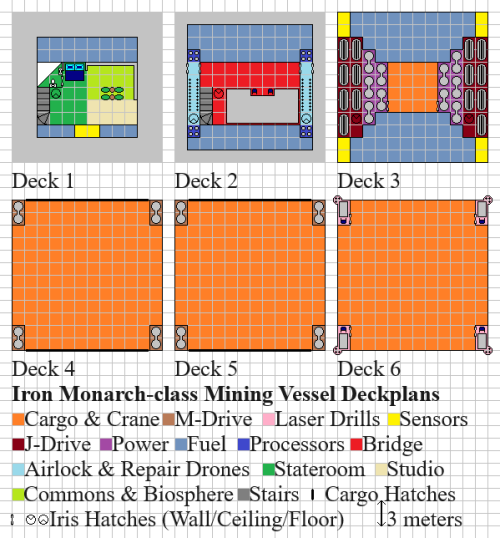
While the design technically qualifies as a "tailsitter", in that the primary direction of thrust is along the axis of gravity and it is designed to land with the engines pointed down, only the two top decks are intended for habitation: one large living area on deck 1, then the bridge and airlocks on deck 2. The rest of the ship is designed for traversal by the repair drones. The remaining length of ship up to its midpoint is designated "deck 3", mainly holding the [[jump drive]] and [[power plant]]. Decks 4-6 are even more notional, being mostly a single cavernous [[cargo bay]]; there is a physical feature (where the [[turret]]s end and the [[maneuver drive]]s begin) noting the line between decks 5 and 6, but not between decks 4 and 5. | While the design technically qualifies as a "tailsitter", in that the primary direction of thrust is along the axis of gravity and it is designed to land with the engines pointed down, only the two top decks are intended for habitation: one large living area on deck 1, then the bridge and airlocks on deck 2. The rest of the ship is designed for traversal by the repair drones. The remaining length of ship up to its midpoint is designated "deck 3", mainly holding the [[jump drive]] and [[power plant]]. Decks 4-6 are even more notional, being mostly a single cavernous [[cargo bay]]; there is a physical feature (where the [[turret]]s end and the [[maneuver drive]]s begin) noting the line between decks 5 and 6, but not between decks 4 and 5. | ||
| + | |||
| + | The sensors are biased forward. They can detect behind the ship well enough to direct mining operations at less than 100 meters distance, especially in concert with the repair drones' sensors, but when prospecting the ship is pointed toward the area being scanned, flipping around after selecting a target to mine and approaching it. | ||
Being designed for [[belter]]s who are used to solitary lives but also paying attention to economical minimums, the habitable space is a balance between allowing for two while supporting someone alone. Deck 1's main features are a bathroom with [[airlock]]-grade atmospheric containment (overkill, but it does trap odors within while the iris valve is closed), a bed that can sleep 2 or 3 with end tables along either side, a [[galley]]/dining area with scaled-down appliances normally only found on high end [[passenger liner]]s and enough biosphere to keep 2 typical adult sophonts well fed (some solo owners put on weight over time), and a reconfigurable studio to allow the practice of some art or other profession while the ship mines and traverses [[jumpspace]]. Possibly the most luxurious element, by [[spacer]] standards, is an actual staircase leading to deck 2; as many prospective buyers were uncomfortable with this as the only means of access, a more traditional grav lift is also provided, though experience has shown that ship owners quickly get used to it, especially with focused adjustable gravitics that allow someone to float or slide up or down the staircase on demand. The lone concession to engineering necessities is an access panel leading to part of the ship's [[sensor]]s. | Being designed for [[belter]]s who are used to solitary lives but also paying attention to economical minimums, the habitable space is a balance between allowing for two while supporting someone alone. Deck 1's main features are a bathroom with [[airlock]]-grade atmospheric containment (overkill, but it does trap odors within while the iris valve is closed), a bed that can sleep 2 or 3 with end tables along either side, a [[galley]]/dining area with scaled-down appliances normally only found on high end [[passenger liner]]s and enough biosphere to keep 2 typical adult sophonts well fed (some solo owners put on weight over time), and a reconfigurable studio to allow the practice of some art or other profession while the ship mines and traverses [[jumpspace]]. Possibly the most luxurious element, by [[spacer]] standards, is an actual staircase leading to deck 2; as many prospective buyers were uncomfortable with this as the only means of access, a more traditional grav lift is also provided, though experience has shown that ship owners quickly get used to it, especially with focused adjustable gravitics that allow someone to float or slide up or down the staircase on demand. The lone concession to engineering necessities is an access panel leading to part of the ship's [[sensor]]s. | ||
Revision as of 22:31, 8 October 2023
| Iron Monarch class Mining Vessel | |
|---|---|
 A yacht for belters | |
| Type: JM Mining Vessel | |
| Category | ACS |
| Size | 400 Tons |
| Hull Configuration | Box Hull |
| Streamlining | Unstreamlined Hull |
| Tech Level | TL–12 |
| Engineering | |
| Computer | Model/2 |
| Jump | J-1 |
| Maneuver | 2 G |
| Fuel Treatment | Scoops, Purifier |
| Armaments | |
| Hardpoints | 4 |
| Offensive | 4 triple turrets with laser drills |
| Accommodations | |
| Staterooms | 1 |
| Personnel | |
| Crew | 1 |
| High/Mid Passengers | |
| Payload | |
| Cargo | 209.5 Tons |
| Fuel tank | 60 Tons |
| Carried craft | none |
| Construction | |
| Origin | Old Earth Union |
| Year Operational | -901 |
| Price | |
| Cost | MCr120.71 |
| Maintenance cost | Cr10,059 |
| Statistics | |
| Quick Ship Profile | JM-DU21 |
| Universal Ship Profile | JM-B4812U |
| Images | |
| Blueprint | Yes |
| Illustration | No |
| Source | |
| Canon | Unpublished, fan design |
| Designer | Adrian Tymes |
| Design System | Mongoose 2nd |
| Era | Long Night |
| Reference | Fan: Adrian Tymes |
The Iron Monarch class Mining Vessel is a mining vessel built with yacht sensibilities.
Description
The Iron Monarch class Mining Vessel is quickly recognizable by its outline: a near-cube, topped by two smaller decks in a ziggurat-like configuration. Most of the bulky rear is a hollow cargo bay to transport roughly a couple hundred tons of ore that it mines.
The class is notable for only requiring a single crew member: one astrogator. Even this is optional if the ship stays within one system, such as when travelling between a mainworld and a planetoid belt in the same system. It has a jump drive with fuel for two single-parsec jumps as a secondary function, often used for microjumps when it would take more than a week to reach the belt. Everything else is automated: pilot, sensor operator for prospecting, and gunners for mining are all run from the ship's computer, while repair drones tend to what little maintenance is needed when they are not gathering ore or tending to the ship's occupant. There is life support for two - a design compromise spurred in part by the minimum effective scale of certain components that help achieve the luxurious standard of living aboard - but the class's early advertising emphasized a ship for one person.
The living standards approach that of high passage, but the lack of a sophont steward - or indeed, anyone else at all - is widely seen as holding it back somewhat. Even if further software is acquired to help with the astrogation, the sophont crew still has to do a little bit of work: picking destinations, authorizing mining (taking responsibility for not jumping someone else's claim), coordinating sale of the ore once back at port, and so on. That said, most of the owner's time in practice is spent on other tasks such as art.
General Description & Deck Plans
- Deck Plans for this vessel.

Basic Ship Characteristics
Following the Imperial Navy and IISS Universal Ship Profile and data, additional information is presented in the format shown here [1]
| Basic Ship Characteristics [2] | ||
|---|---|---|
| No. | Category | Remarks |
| 1. | Tonnage / Hull | Tonnage: 400 tons (standard). 5600 cubic meters. Unstreamlined Box Hull.
|
| 2. | Crew | Crew: crew: 1 Astrogator. Pilot, Gunners, and Sensor Operator provided by software. |
| 3. | Performance | Acceleration: 2-G maneuver drive installed.
|
| 4. | Electronics | Model/2. |
| 5. | Hardpoints | 4 hardpoints, all used. |
| 6. | Armament | 4 triple-mount turrets equipped with laser drills. |
| 7. | Defenses | None. |
| 8. | Craft | None. Vacc suits required for EVA (extra-vehicle activity). Rescue Balls for crew escape normally carried.. |
| 9. | Fuel Treatment | It is typically equipped with a fuel purification plant and fuel scoops. |
| 10. | Cost | MCr120.71. MCr108.639 in quantity. Architect's fee donated by Old Earth Union to make the design more available. |
| 11. | Construction Time | 4 months standard, 3 in quantity. This includes the typical amount of time to fit out the ship to the first owner's initial tastes, to the point that it is ready for its maiden voyage. |
| 12. | Remarks | A luxurious, single-crew mining vessel. |
History & Background
The Iron Monarch class Mining Vessel was one of the lesser "false dawns": an effort to rekindle interstellar trade during the Long Night that ultimately came up short. Its architects thought that the mere existence of a ship class for belters that would handle all the mining while supporting its owner in the best luxury that an automated starship could offer would inspire more belt mining and, with it, more trade and contact between systems. Historical records show much debate and confusion at the time about this chain of logic.
Whatever the reasoning, it did not stand the test of time. The class gained very limited acceptance as something that successful belters could aspire to own and operate independently, but it proved to be less economical than larger ships. Mining and hauling just common ores was not sufficient to pay the mortgage in theory, though in practice the kind of person who would buy an Iron Monarch could pay the full price up front. It came to be seen as a ship for those who worked their way into wealth and, while they did not want to be seen as retired or idle rich, did appreciate the luxuries that wealth could buy. In modern use, Iron Monarch owners are almost always anagathic users, sustained at whatever age they were when they came into wealth - which means that quite a few have been flying their Iron Monarch for over a century. Few of them become complete hermits - they got an Iron Monarch because they cared about how they were seen, and even with anagathics, longevity is aided by having access to good medical care - but many prefer to rarely leave their ships.
Enough Iron Monarchs were built that, by the time the Third Imperium arose and eventually contacted the Old Earth Union, this ship class design was among the many that then became available to Imperial shipyards. Modern versions swap out the power plant to Fusion+ designs and do other standard modernizations but are similar enough that it can be hard to tell the difference if one does not know what to look for.
Class Naming Practice/s & Peculiarities
Ship Interior Details (Peculiarities): While the design technically qualifies as a "tailsitter", in that the primary direction of thrust is along the axis of gravity and it is designed to land with the engines pointed down, only the two top decks are intended for habitation: one large living area on deck 1, then the bridge and airlocks on deck 2. The rest of the ship is designed for traversal by the repair drones. The remaining length of ship up to its midpoint is designated "deck 3", mainly holding the jump drive and power plant. Decks 4-6 are even more notional, being mostly a single cavernous cargo bay; there is a physical feature (where the turrets end and the maneuver drives begin) noting the line between decks 5 and 6, but not between decks 4 and 5.
The sensors are biased forward. They can detect behind the ship well enough to direct mining operations at less than 100 meters distance, especially in concert with the repair drones' sensors, but when prospecting the ship is pointed toward the area being scanned, flipping around after selecting a target to mine and approaching it.
Being designed for belters who are used to solitary lives but also paying attention to economical minimums, the habitable space is a balance between allowing for two while supporting someone alone. Deck 1's main features are a bathroom with airlock-grade atmospheric containment (overkill, but it does trap odors within while the iris valve is closed), a bed that can sleep 2 or 3 with end tables along either side, a galley/dining area with scaled-down appliances normally only found on high end passenger liners and enough biosphere to keep 2 typical adult sophonts well fed (some solo owners put on weight over time), and a reconfigurable studio to allow the practice of some art or other profession while the ship mines and traverses jumpspace. Possibly the most luxurious element, by spacer standards, is an actual staircase leading to deck 2; as many prospective buyers were uncomfortable with this as the only means of access, a more traditional grav lift is also provided, though experience has shown that ship owners quickly get used to it, especially with focused adjustable gravitics that allow someone to float or slide up or down the staircase on demand. The lone concession to engineering necessities is an access panel leading to part of the ship's sensors.
The bridge is dominated by the main computer, with a pair of control stations. One of them is packed up - the chair folded, the controls and readouts turned off and under a disposable protective dust cover - by default. To either side is a combination airlock and repair drone hangar, providing access to the fuel processors to either side and the power plant beneath. The outer doors of the airlocks are quite some distance above the ground when the ship is landed (typically 14-16 meters from the ground to the bottom of the airlock doors, depending on how far the landing gears are extended); to compensate, they come with staircases that can unroll into variable-length (18-27 meters) ramps, though it is not uncommon for owners to summon a repair drone to ferry them between airlock and ground, especially if they have any significant luggage.
Deck 3 could be called the engineering deck. The power plant and jump drive are arranged with what could better be described as crawlspaces than accessways, though a typical adult human can navigate this area if necessary. At the middle is the top of the cargo bay, including most of the machinery for the cargo crane that sorts and packs the bay's contents.
Aside from the cargo bay itself, decks 4-6 feature the maneuver drives in each corner, with the turrets on the bottom. Having the maneuver drives not be part of the actual back face is a slightly unconventional design choice, but the ship is designed to present its rear to any asteroid it is mining so as to minimize the distance the repair drones must cover when going out to retrieve ore chunks the drills have blasted loose and returning them to the cargo bay. The familiar blue maneuver drive ionization glow happens along the corners of the rear of the sides of the ship instead of the rear face. The turrets are intended to be operated by the ship's computer, but include manual control stations as backups. These stations are often configured with full access to control the ship and never changed from that default. This is particularly a worry because the cargo bay features two large hatches that are normally slid up when landed to allow quick cargo transfer, making it easy for anyone to just walk in and get to the turrets (if not intercepted by the cargo crane, which can grab and throw around even multi-ton sophonts let alone a typical human), though their iris valve entrances run the same security as the airlock doors and often come without manual overrides, requiring partial disassembly to force an entrance.
Class Naming Practice/s: Iron Monarch names follow typical trends for yachts, driven by the owners' personal eccentricities, though many follow the class name's pattern: some kind of minable substance then some noble title, for instance Amethyst Archduke, Nickel Knight, or Platinum Prince.
Selected Variant Types & Classes
0 Representative Mining Vessel (JM) Classes
References
| This article has metadata. |

|
This ship was designed using Mongoose 2nd ship design rules.
|

|
This article is missing content for one or more detailed sections. Additional details are required to complete the article. You can help the Traveller Wiki by expanding it. |
- Author: Adrian Tymes
- ↑ Timothy B. Brown. Fighting Ships (Game Designers Workshop, 1981), 10.
- ↑ Timothy B. Brown. Fighting Ships (Game Designers Workshop, 1981), 10.