Kivu Subsector
| Kivu Subsector | |
|---|---|
 | |
| Sector | Corridor |
| Capital | None |
| Number of Systems | 6 |
| Majority Control | Imperium - 83% |
| 2nd Control | Non-Aligned - 17% |
| Map Key | Map Key |

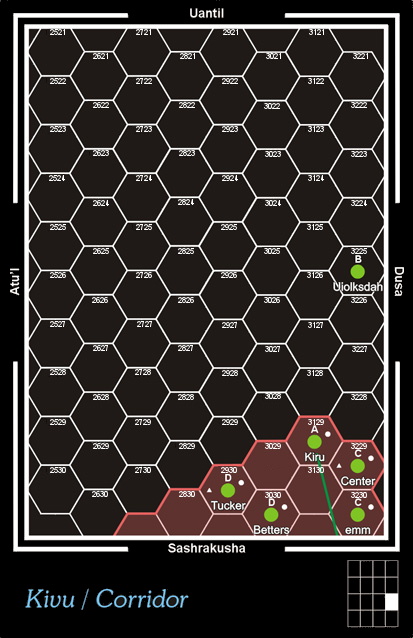
Subsector L of Corridor Sector, which largely falls within the Great Rift.
Description[edit]
No information yet available.
Subsector Summary: 1116[edit]
Kivu, subsector L of Corridor, contains six worlds with an estimated combined population of 86 million, a per capita income of Cr5,244, and a total economy of BCr451. These worlds originate an interstellar trade of BCr13 through 6 starports (1 Class A, 1 Class B, 2 Class C, 2 Class D) employing 5,425 people. Driving this interstellar trade are two Agricultural (Ag) worlds, no Non-Agricultural (Na) worlds, no Pre-Agricultural (Pa) worlds, one Pre-Industrial (Pi) world, one Rich (Ri) world, and no Industrial (In) worlds. The governments in Kivu maintain two Scout bases. The average technology level is 7 (with most between 5 and 9). The highest technology level is 12 at Uiolksdah (Corridor 3225).
Kivu, subsector L of Corridor, contains eight stars and 57 identified planets; five monostellar systems, no binary systems, one trinary system, and no systems with four or more stars. 5 of the six systems (83%) have native gas giants. There are no Asteroid (As) belts, no Desert (De) worlds, no Garden (Ga) worlds, no Ice-capped (Ic) worlds, two Poor (Po) worlds, no Vacuum (Va) worlds, and no Water (Wa) or Ocean (Oc) worlds.
Kivu has an estimated population of 86 million distributed across no High population (Hi) worlds, no Moderate population (Ph) worlds, four Non-industrial (Ni) worlds, one Low population (Lo) world, and no Barren (Ba) worlds. The highest population world is Uiolksdah (Corridor 3225). The population consists primarily of 1 sophont group.
| 1 identified sophont population in Kivu | |
|---|---|
|
Third Imperium[edit]
The Third Imperium has jurisdiction over five worlds in the subsector with an estimated combined population of 16 million, a per capita income of Cr2,562, and a total economy of BCr41. These worlds originate an interstellar trade of BCr13 through 5 starports (1 Class A, 0 Class B, 2 Class C, 2 Class D) employing 5,330 people. Driving this interstellar trade are two Agricultural (Ag) worlds, no Non-Agricultural (Na) worlds, no Pre-Agricultural (Pa) worlds, no Pre-Industrial (Pi) worlds, one Rich (Ri) world, and no Industrial (In) worlds. The governments in the Third Imperium maintain two Scout bases within the subsector. The average technology level is 6 (with most between 5 and 8). The highest technology level is 9 at Kivu (Corridor 3129).
The Third Imperium has an estimated population of 16 million within the subsector, distributed across no High population (Hi) worlds, no Moderate population (Ph) worlds, four Non-industrial (Ni) worlds, one Low population (Lo) world, and no Barren (Ba) worlds. The highest population worlds are Tucker (Corridor 2930), Kivu (Corridor 3129), and Center (Corridor 3229). The population consists primarily of 1 sophont group.
Non-Aligned, Human-dominated[edit]
There is one Non-Aligned Human-dominated world in Kivu with an estimated population of 70 million.
Astrographic Features[edit]
World Listing: 1116[edit]
History & Background (Dossier)[edit]
No information yet available.
Polity Listing: 1116[edit]
- Non-Aligned (Human-dominated)
- Third Imperium
Native Sophonts[edit]
None.
References[edit]
- Jim Cunningham, John Harshman, J. Andrew Keith, Marc W. Miller, Gordon Sheridan. Atlas of the Imperium (Game Designers Workshop, 1984), .
- Marc Miller. Rebellion Sourcebook (Game Designers Workshop, 1988), 26.
- Gary L. Thomas. "Corridor Sector Data/Library." The Travellers' Digest 18 (1989): 33-34.
- Marc Miller. First Survey (Imperium Games, 1996), .
- Martin Dougherty. The Great Rift (Mongoose Publishing, 2018), 62-63.