Difference between revisions of "Flagship"
| Line 12: | Line 12: | ||
== History & Background ([[Dossier]]) == | == History & Background ([[Dossier]]) == | ||
| − | + | In common naval use, the term flagship is fundamentally a temporary designation; the flagship is wherever the admiral's flag is being flown. However, admirals have always needed additional facilities, including a meeting room large enough to hold all the captains of the fleet and a place for the admiral's staff to make plans and draw up orders. Historically, only larger ships could accommodate such requirements. | |
| + | The term was also used by commercial fleets, when the distinction between a nation's navy and merchant fleet was not clear. An example was Sea Venture, flagship of the fleet of the Virginia Company, which was captained by Royal Navy Vice-Admiral Christopher Newport yet bore the Merchant Navy admiral of the company's fleet, Sir George Somers, during the ill-fated Third Supply of 1609. | ||
| + | In the age of sailing ships, the flagship was typically a first rate; the aft of one of the three decks would become the admiral's quarters and staff offices. This can be seen on HMS Victory, the flagship of Admiral Nelson at the Battle of Trafalgar in 1805, still serving the Royal Navy as the ceremonial flagship of the First Sea Lord from Portsmouth, England. Non-first rates could serve as flagships, however: USS Constitution, a frigate (a fifth rate), served as flagship for parts of the United States Navy during the early 19th century. | ||
| + | In the 20th century, ships became large enough that the larger types, cruisers and up, could accommodate a commander and staff. Some larger ships may have a separate flag bridge for use by the admiral and his staff while the captain commands from the main navigation bridge. Because its primary function is to coordinate a fleet, a flagship is not necessarily more heavily armed or armored than other ships. During World War II admirals often preferred a faster ship over the largest one. | ||
| + | Modern flagships are designed primarily for command and control rather than for fighting, and are also known as command ships. | ||
== References & Contributors ([[Sources]]) == | == References & Contributors ([[Sources]]) == | ||
Revision as of 14:07, 26 August 2019

A Flagship is a vessel used by the commanding officer of a group of naval ships, characteristically a flag officer entitled by custom to fly a distinguishing flag.
- Used more loosely, it is the lead ship in a fleet of vessels, typically the first (namesake), largest, fastest, most heavily armed, or best known.
Description (Specifications)
It is a common practice that such vessels are the most capable or powerful in the fleet.
- Extra comforts may be built into such ships for the enjoyments of flag officers and their guests.
- Such vessels may feature extra communications gear or more powerful subcraft for interfleet communications.
Image Repository
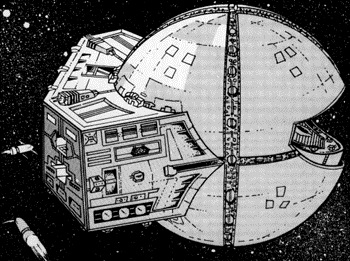
- Tigress class Dreadnoughts are often used as flagships within the Imperial Navy.

History & Background (Dossier)
In common naval use, the term flagship is fundamentally a temporary designation; the flagship is wherever the admiral's flag is being flown. However, admirals have always needed additional facilities, including a meeting room large enough to hold all the captains of the fleet and a place for the admiral's staff to make plans and draw up orders. Historically, only larger ships could accommodate such requirements. The term was also used by commercial fleets, when the distinction between a nation's navy and merchant fleet was not clear. An example was Sea Venture, flagship of the fleet of the Virginia Company, which was captained by Royal Navy Vice-Admiral Christopher Newport yet bore the Merchant Navy admiral of the company's fleet, Sir George Somers, during the ill-fated Third Supply of 1609. In the age of sailing ships, the flagship was typically a first rate; the aft of one of the three decks would become the admiral's quarters and staff offices. This can be seen on HMS Victory, the flagship of Admiral Nelson at the Battle of Trafalgar in 1805, still serving the Royal Navy as the ceremonial flagship of the First Sea Lord from Portsmouth, England. Non-first rates could serve as flagships, however: USS Constitution, a frigate (a fifth rate), served as flagship for parts of the United States Navy during the early 19th century. In the 20th century, ships became large enough that the larger types, cruisers and up, could accommodate a commander and staff. Some larger ships may have a separate flag bridge for use by the admiral and his staff while the captain commands from the main navigation bridge. Because its primary function is to coordinate a fleet, a flagship is not necessarily more heavily armed or armored than other ships. During World War II admirals often preferred a faster ship over the largest one. Modern flagships are designed primarily for command and control rather than for fighting, and are also known as command ships.
References & Contributors (Sources)

|
This page uses content from Wikipedia. The original article was at Flagship. The list of authors can be seen in the page history. The text of Wikipedia is available under the Commons Attribution-ShareAlike 3.0 Unported License. |

|
This article is missing content for one or more detailed sections. Additional details are required to complete the article. You can help the Traveller Wiki by expanding it. |
- TBD
- Traveller Wiki Editorial Team
- Author & Contributor: Lord (Marquis) and Master of Sophontology Maksim-Smelchak of the Ministry of Science