Difference between revisions of "Spin Habitat"
GypsyComet (talk | contribs) m |
|||
| (6 intermediate revisions by 2 users not shown) | |||
| Line 1: | Line 1: | ||
| − | [[File: | + | [[File: Wiki Navy.png|right]] |
A [[Spin Habitat]] simulates gravity through centripetal acceleration. | A [[Spin Habitat]] simulates gravity through centripetal acceleration. | ||
* It is a type of [[Ship Equipment]]. | * It is a type of [[Ship Equipment]]. | ||
| − | * It | + | * It was one of the dominant technologies used before [[Grav Plate]]s. |
== Description ([[Specifications]]) == | == Description ([[Specifications]]) == | ||
A spin habitat simulates the effects of gravity through rotation, generating centripetal acceleration. This may be referred to as "centrifugal force gravity". | A spin habitat simulates the effects of gravity through rotation, generating centripetal acceleration. This may be referred to as "centrifugal force gravity". | ||
* Its rotation typically produces between 0.35 G and 1.1 G, a range in which most [[sophont]]s can live and work without adverse effects. | * Its rotation typically produces between 0.35 G and 1.1 G, a range in which most [[sophont]]s can live and work without adverse effects. | ||
| + | |||
| + | === Image Repository === | ||
| + | # A lab ship with a ''Spin Habitat''. <br> [[File: Lavalier class.jpg]] | ||
=== Habitats === | === Habitats === | ||
| Line 46: | Line 49: | ||
Most spin habitats are external or ancillary structures on a [[ship]], forming a distinctive part of the [[hull]]. A sufficiently large vessel may have internal spin habitats. | Most spin habitats are external or ancillary structures on a [[ship]], forming a distinctive part of the [[hull]]. A sufficiently large vessel may have internal spin habitats. | ||
| − | |||
| − | |||
| − | |||
== References & Contributors ([[Sources]]) == | == References & Contributors ([[Sources]]) == | ||
{{Advanced}} | {{Advanced}} | ||
{{Sources | {{Sources | ||
| − | | | + | | Author & Contributor: Lord (Marquis) and Master Scout Emeritus [[User: Alagoric|Adie Alegoric Stewart]] of the [[IISS]] |
| − | |||
| − | |||
}} | }} | ||
Latest revision as of 04:23, 22 March 2024

A Spin Habitat simulates gravity through centripetal acceleration.
- It is a type of Ship Equipment.
- It was one of the dominant technologies used before Grav Plates.
Description (Specifications)[edit]
A spin habitat simulates the effects of gravity through rotation, generating centripetal acceleration. This may be referred to as "centrifugal force gravity".
- Its rotation typically produces between 0.35 G and 1.1 G, a range in which most sophonts can live and work without adverse effects.
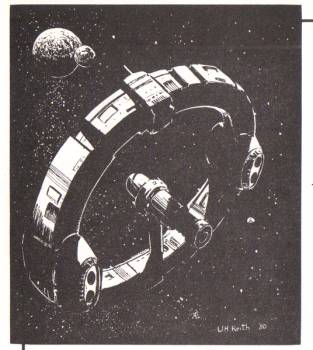
Image Repository[edit]
- A lab ship with a Spin Habitat.

Habitats[edit]
It consists of one or more habitats, which generally have their own Life Support and environmental systems.
- Tethered habitats (ie pods linked by cables)
- Tether materials.
- Spin pods.
- Arms (may contain elevators or ladders).
- Ring habitats (such as the hull of a Type L class Laboratory Ship).
- Rotational hull (generally cylinder configuration).
Rotation[edit]
Rotation around a fixed axis.
- Up and down relative to the spin axis. Outward is downward.
Rotation speed vs distance from central spin axis.
- Rotation speeds in meters per second.
- Arm lengths are typically tens of meters.
- Physiological limitations on rotation rate.
Control[edit]
Torque and progressional instability. Countered by:
- Counter-rotating pods.
- Counterweights.
- Stabilizing gyroscopes.
- Thrusters.
Coriolis effect.
- Targeting effects.
- Nausea.
History & Background (Dossier)[edit]
Spin habitats are largely redundant due to the widespread availability of Grav Plates and Gravity Control Technology. However, they may still be employed by vessels constructed at TL-7 or less, or on vessels that may require a gravity-free environment such as Research Ships. Very large structures such as space stations or orbital arcologies may utilize spin habitat technology rather than costly gravitic devices.
- The Type L class Laboratory Ship is an example of a vessel that uses Spin Habitat technology.
Deliberately spinning a non-spin habitat vessel.
Spin habitats are generally locked during acceleration.
Most spin habitats are external or ancillary structures on a ship, forming a distinctive part of the hull. A sufficiently large vessel may have internal spin habitats.
References & Contributors (Sources)[edit]
- Author & Contributor: Lord (Marquis) and Master Scout Emeritus Adie Alegoric Stewart of the IISS